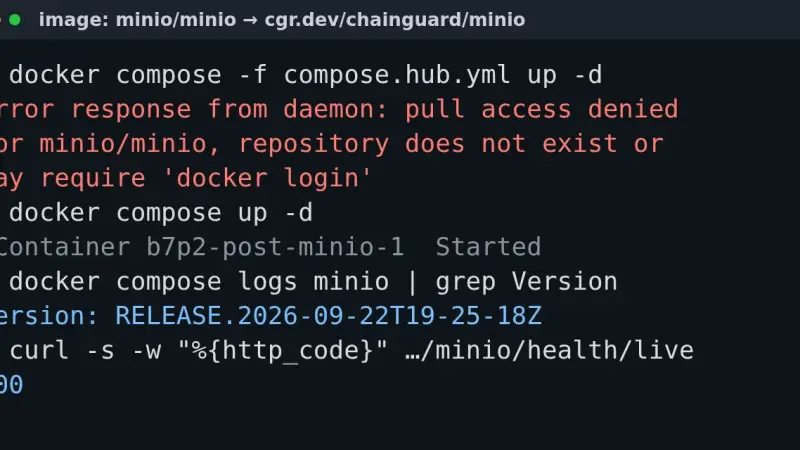
The pull access denied for minio/minio error appears because MinIO removed its Docker Hub images in September 2026, and quay.io has required an account since the 24th. Point your compose file at cgr.dev/chainguard/minio, at the pgsty/silo fork or at an image built from source: your existing data keeps working.
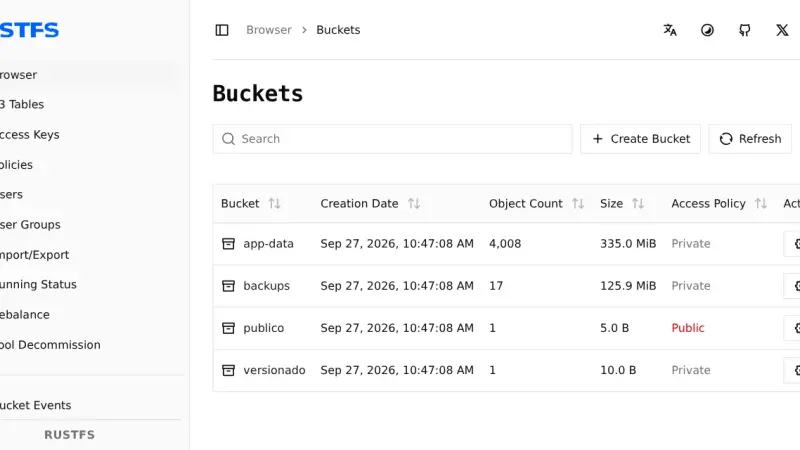
To migrate from MinIO to RustFS 1.0 with Docker, run RustFS next to MinIO, import the users with mc admin cluster iam, copy the buckets with rclone sync --metadata and compare them with rclone check --download. In my test 4,012 objects arrived identical; versions, tags and public access had to be redone by hand.
MinIO images no longer pull from Docker Hub, and the quay.io copy is frozen in 2025. To migrate from MinIO to Garage with Docker, run Garage v2.4.1 next to MinIO, copy the buckets with rclone sync, verify them with rclone check, and switch endpoint, keys and region in your clients.
restic is the encrypted, deduplicated, incremental backup tool I run in production on several servers. A practical guide to installing it on Debian, setting up an S3-compatible repository, automating daily backups with systemd, and verifying that restore actually works before you need it.
JuiceFS is a distributed, POSIX-compliant file system that separates data, stored in an S3-compatible object store, from metadata, stored in a database such as PostgreSQL or Redis. This guide installs JuiceFS on a three-node Linux cluster to share files without relying on NFS.
Litestream is an open-source tool that replicates a SQLite database to an S3 bucket in near real time by reading the WAL SQLite already writes. It offers point-in-time recovery, overhead of only 1 to 3% CPU, and replaces the need for a separate database server in small apps.
8 min5494.1
We use first- and third-party cookies to analyze site traffic. You can accept them, reject them, or configure your choice.
Learn more about cookies
Cookie preferences
NecessaryEssential for the site to work. Always on.
AnalyticsHelp us understand how the site is used (Google Analytics).