Syncthing is a free peer-to-peer file synchronisation tool: it keeps folders identical across your devices without going through the cloud and with all traffic encrypted. With Docker you bring it up from a single docker-compose.yml using host networking, PUID/PGID for permissions and a persistent volume. This guide covers the installation, device pairing and the ports you need.
MinIO is an object storage server compatible with the Amazon S3 API that you can self-host with Docker. With a single docker-compose.yml you bring up the API on port 9000 and the console on 9001, create buckets and access keys with the mc client, and use it as an S3 backend for backups, attachments and photos.
Adminer and pgweb are two web-based database managers that run in Docker with a single container each. Adminer is one PHP file that handles MySQL, PostgreSQL and six other engines; pgweb is a Go explorer dedicated to PostgreSQL. This guide brings a ready-to-copy docker-compose.yml and explains how to secure them properly.
Redis is an in-memory key-value data store used as a cache, a job queue and a session manager. With Docker you bring it up from a single docker-compose.yml file, with persistence on a volume, a mandatory password and a healthcheck. This guide covers the installation, how to secure it and how it differs from Valkey.
MariaDB is an open-source relational database, a fork of MySQL and compatible with it, that in Docker runs as a single container with a persistent volume. With this docker-compose.yml you set the root password, the database and the initial user through environment variables, and you keep your data even if you recreate the container.
PostgreSQL is the most advanced open-source relational database, and in Docker you bring it up with a single docker-compose.yml file. You define a persistent volume, the superuser password and a pg_isready healthcheck, and within seconds you have a server on port 5432 ready for other containers to connect to it by the service name.
Firefly III is an open-source personal finance manager you self-host with Docker. With one docker-compose.yml file you bring up the application, a MariaDB database and the data importer, which connects to more than 6,000 banks through GoCardless. You generate the 32-character APP_KEY and keep control of all your money on your own server.
Stirling-PDF is a web-based Swiss Army knife for PDFs that you self-host with Docker in a single container. With one docker-compose.yml file you bring up more than fifty tools to merge, split, compress, convert, sign and OCR your documents, all processed on your own server and without sending anything to the cloud.
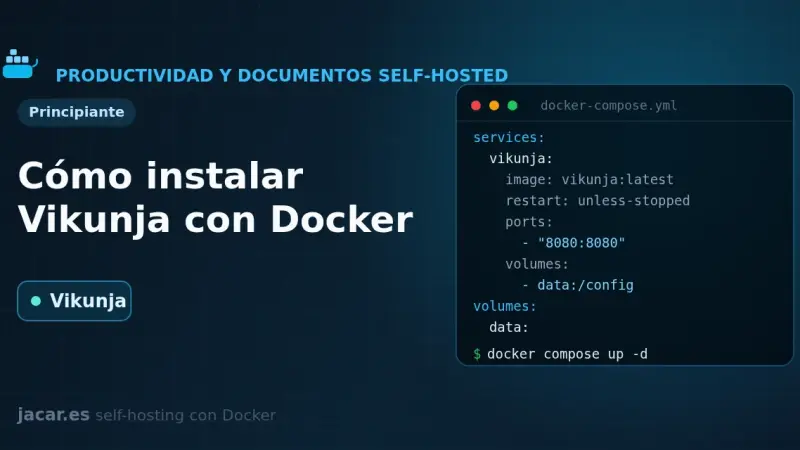
Vikunja is an open-source task manager that you self-host with Docker in a single image. With one docker-compose.yml file you bring up the application alongside a PostgreSQL database and organize your projects in list, kanban board, Gantt and table views, with all your data stored on your own server.
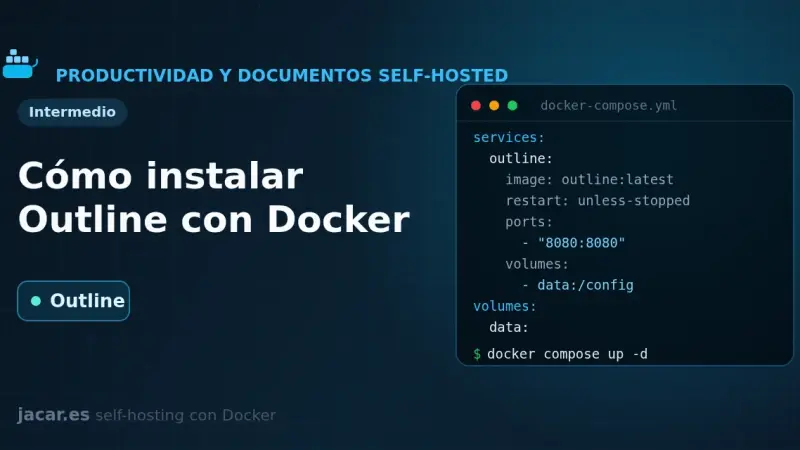
Outline is a source-available team wiki and knowledge base that in Docker needs three pieces: PostgreSQL, Redis and a login provider, because it ships with no local username and password. With one docker-compose.yml file you bring up the service, connect it to Authentik over OIDC and store attachments in MinIO.
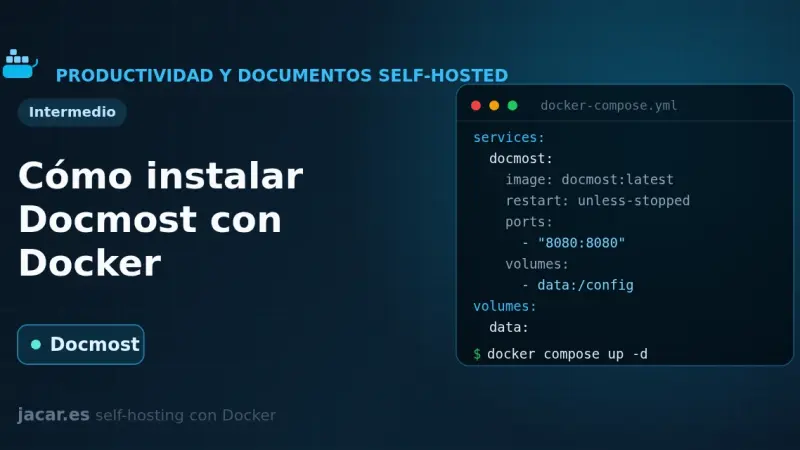
Docmost is an open-source wiki and knowledge base, a self-hosted alternative to Confluence and Notion. On Docker it runs as three containers: the application, a PostgreSQL database and a Redis cache. A single docker-compose.yml file gives you workspaces, real-time collaborative editing and full control over your documents.
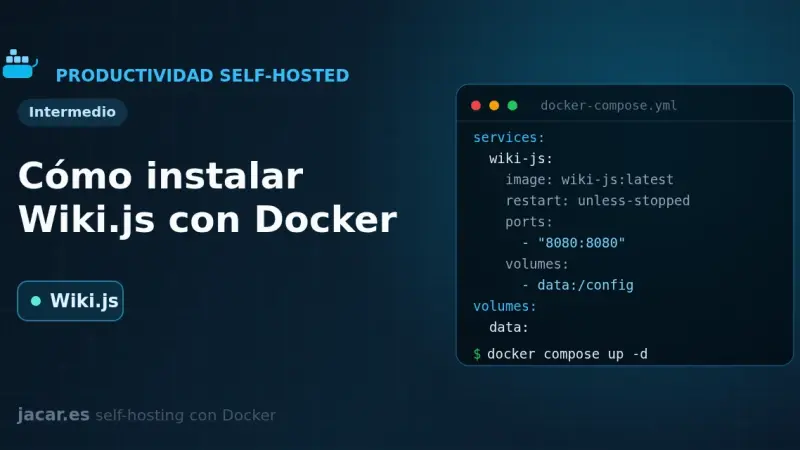
Wiki.js is an open-source wiki engine written in Node.js that, in Docker, runs as two containers: the application and a PostgreSQL database. With a single docker-compose.yml file you get your own wiki with a Markdown editor, version control and more than forty authentication methods, and your pages stored in a volume that you control.
Paperless-ngx is an open-source document manager that digitises and archives your papers with full-text search. In Docker it runs as five containers (application, PostgreSQL database, Valkey queue, Gotenberg and Tika) through a single docker-compose.yml, and it performs OCR and automatic tagging on every document you drop into its consume folder.
Nextcloud is an open-source private cloud platform that, in Docker, runs as three containers: the application, a MariaDB database and a Redis cache. With a single docker-compose.yml file you get your own self-hosted Drive, calendar and contacts in minutes, with your data stored in a volume that you control.
Watchtower is a container that watches your Docker registries, detects when a newer image is available, pulls it and recreates your container with the same options. You configure it with a small docker-compose.yml, it polls every 24 hours by default, and you can restrict it with labels or keep it in notify-only mode.
Docker Compose profiles tag services so they only start when you enable their profile with --profile or COMPOSE_PROFILES. Services without a profile always run; tagged ones stay idle until you ask for them. That lets a single file hold the core stack, debugging tools and optional extras without duplicate compose files.
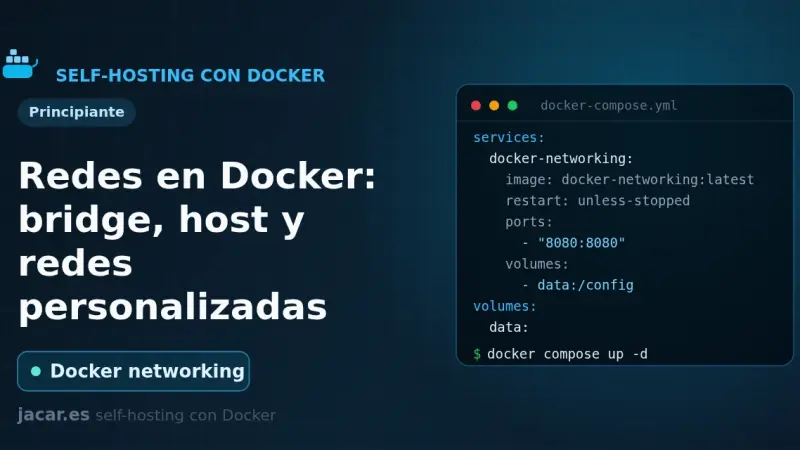
Docker ships six network drivers: bridge, host, none, overlay, macvlan and ipvlan. The default bridge network connects containers by IP but without name resolution. A user-defined bridge adds an internal DNS server so services find each other by name, and it is the recommended choice for almost any deployment.
8 min
We use first- and third-party cookies to analyze site traffic. You can accept them, reject them, or configure your choice.
Learn more about cookies
Cookie preferences
NecessaryEssential for the site to work. Always on.
AnalyticsHelp us understand how the site is used (Google Analytics).