Claude 3.5 Sonnet (Anthropic, June 2024) matches Claude 3 Opus quality at Sonnet pricing, with a 200k-token context window and 92% on HumanEval. It stands out in coding and complex instruction-following, and introduced the Artifacts workspace feature on Claude.ai.
Mistral Large 2, released by French startup Mistral AI in July 2024, is a 123-billion-parameter model with a 128k-token context window that rivals GPT-4o and Claude 3.5 Sonnet on several benchmarks. Its EU data residency and its 3 EUR per million input tokens pricing make it the most serious European alternative to US providers.
The EU AI Act (Regulation 2024/1689) entered force on 1 August 2024. It classifies AI systems into four risk levels with graduated deadlines: prohibitions in February 2025, GPAI obligations in August 2025, and high-risk requirements in August 2026. It applies to any company operating or selling in the EU, with fines exceeding GDPR levels.
Installing Ollama on an Apple Silicon Mac is as simple as running one Homebrew command. Then pick a model based on available RAM (Phi-3 for 8 GB, Llama 3.1 8B for 16 GB) and expose the local, OpenAI-compatible HTTP API on port 11434 to plug it into your own applications.
Meta released Llama 3.1 405B on July 23, 2024: 405 billion parameters, 128k token context, and benchmarks matching GPT-4o and Claude 3.5 Sonnet. Self-hosting needs about 220 GB of VRAM in Q4; Together.ai, Fireworks, and Groq offer per-token access.
GPT-4 Turbo, released in November 2023, expanded GPT-4's context to 128,000 tokens and cut the input price threefold, down to 10 dollars per million tokens. GPT-4o now beats it on price, speed and answer quality, but Turbo still holds up in stable production apps, contracts pinned to a specific version, and deterministic tests that depend on its exact behaviour.
Evaluating a RAG system without metrics is pure guesswork. Ragas measures four core signals: faithfulness, answer relevancy, context precision and context recall, using an LLM as judge. TruLens, DeepEval and other frameworks cover similar ground. Wiring evaluation into CI from day one catches regressions in prompts, chunking or model choice before they reach production.
SGLang adds a Python DSL for controlling LLM generation with constrained decoding, parallel branching, and RadixAttention, the structure that indexes the KV cache as a radix trie to reuse shared prefixes across requests. When that pattern exists, speedups over vLLM reach up to 5 times; without it, the advantage shrinks.
GPT-4o is the OpenAI model presented on May 13, 2024, that fuses text, image, and audio into a single native model, without separate pipelines. It delivers roughly 320-millisecond conversational latency, better multimodal understanding, and a price 50% lower than GPT-4 Turbo.
Llama 3 is the open-model family Meta released on April 18, 2024, in 8-billion and 70-billion-parameter sizes, trained on 15 trillion tokens. The 70B beat Claude Sonnet, Mistral Medium, and GPT-3.5 in Meta's own human evaluation, and its licence allows free commercial use up to 700 million monthly active users.
nomic-embed-text-v1.5 from Nomic AI is an embedding model with weights, code and training data released under Apache 2.0: 137 million parameters, up to 8192 tokens of context, and an MTEB score of 62.4, almost matching the 62.3 of OpenAI's text-embedding-3-small, at 768 dimensions instead of 1536.
LangGraph modela agentes LLM como grafos de estados explícitos. Cuándo supera al bucle tradicional de LangChain y cómo estructurar flujos que no se desmoronan en producción.
Outlines, Guidance e Instructor obligan al modelo a emitir JSON válido en el propio paso de generación. Cuándo ganan frente a reintentos y function calling.
Anthropic launched the Claude 3 family on March 4, 2024 with three models: Haiku, Sonnet, and Opus, all with 200k-token context. Haiku costs $0.25 per million tokens; Opus matches GPT-4 Turbo on benchmarks. This comparison explains when to choose each tier and how to combine them in production to cut costs without sacrificing quality where it matters.
Mixtral 8x22B is Mistral AI's Mixture of Experts model released in April 2024: 141B total parameters but only 39B active per token, an unrestricted Apache 2.0 licence, and multilingual performance ahead of Llama 3 70B in Spanish, French, Italian, and German. Production serving needs datacenter-class GPUs.
LM Studio is a desktop app for Mac, Windows, and Linux that downloads and runs large language models on your own machine, with a polished chat interface and no terminal required. It includes an OpenAI-compatible API and RAG with your documents. For individual use it beats Ollama on user experience; for teams or production, OpenWebUI, vLLM, or TGI are the better fit.
A model trained in PyTorch or TensorFlow, running the same way on a server, a phone, a browser tab, or an ARM gateway on the factory floor: that is what ONNX Runtime solves. It turns the ONNX format into a genuinely portable artifact, exported once, at the cost of some peak performance versus a platform-native runtime.
Cuando una aplicación habla con dos o más proveedores de LLM, antes o después aparece un proxy entre medias. LiteLLM propone uno concreto, y esta es la lectura honesta de qué gana y qué cuesta.
Gemini 1.5 Pro launched in February 2024 with a verified one-million-token context window. It retrieves over 95% of data up to 530,000 tokens in recall tests, reshaping RAG system design, making full-document analysis viable, and enabling new architectural patterns through context caching.
OpenAI released text-embedding-3 on 25 January 2024 in two variants: small and large. It improves MTEB quality over ada-002, adds variable dimensions you can truncate without retraining, and lowers the price for small. Migration pays off for most serious RAG setups, but measure real recall on your own corpus before reindexing everything.
pgvector matured in 2023-2024 with the HNSW index type and parallel construction that arrived in version 0.6. For projects already running PostgreSQL, a dedicated vector database is not needed in most cases: this guide explains when PostgreSQL is enough, how to configure the index, and where it starts to fall short.
Cohere Embed v3 is an embedding model that distinguishes queries from documents via the input_type parameter and scores intrinsic text quality, with multilingual support for over 100 languages at 1024 dimensions. It costs $0.10 per million tokens versus OpenAI's $0.02, and delivers better recall in multilingual RAG.
Text Generation Inference (TGI) is the Hugging Face stack for serving open LLMs in production: continuous batching, 4-bit and 8-bit quantization, streaming, and an OpenAI-compatible API. After a brief restrictive-licence episode in 2023, it returned to Apache 2.0 in version 2.0.
Claude 2, launched by Anthropic in July 2023, offers a 100,000-token context window and safety grounded in Constitutional AI. Against GPT-4 it wins on long-document analysis and wide-context code; GPT-4 remains ahead on complex mathematical reasoning and its tooling ecosystem.
Vector databases have gone from an experimental curiosity to the central component of most LLM-based products. This comparison covers Qdrant, Pinecone, and Weaviate: architecture, strengths, limitations, and a decision tree for choosing the right option based on your operational priorities and budget.
With quantization, model weights are stored with fewer bits (4, 5, or 8 instead of 16), so Llama 2 13B shrinks from 26 GB to about 7.5 GB. With llama.cpp it runs on an ordinary 16GB-RAM laptop with no dedicated GPU, and the quality loss is smaller than intuition suggests.
LangChain is a Python framework that unifies building LLM applications: prompt templates, retrievers over vector databases, function-calling agents, and conversational memory. It earns its keep in fast prototypes and multi-model systems, but for a single well-defined production use case, direct code usually stays more maintainable.
A text embedding is a numeric vector that encodes the meaning of a word or phrase, so that semantically similar pieces of text produce nearby vectors measured by cosine distance. The models most used in production are OpenAI ada-002, Sentence Transformers, and BGE, and they mainly serve semantic search, RAG systems, and text classification without training a classic classifier.
Chroma is the easiest vector database to get started with embeddings and semantic search: install it with pip install chromadb, no extra infrastructure required, and it exposes a minimal API (add, query, delete). It suits prototypes and mid-sized RAG systems well; past a few million vectors, Qdrant or Milvus scale better.
Midjourney v5, released in March 2023, delivers consistent photorealism in skin, light, and depth of field, something v4 could not manage. The --style raw parameter disables the default artistic look, ideal for product photography. It still lacks an official API and only runs through Discord, so Stable Diffusion XL and DALL-E 3 remain more practical for automating pipelines.
In 2023, three frameworks address generative AI regulation differently: the EU AI Act sets four risk tiers with fines up to 6% of global turnover; the US NIST framework is voluntary; the UK delegates to sector regulators. Product teams should inventory AI use cases and document risks now.
Ollama makes it trivial to run models like Llama 2 or Mistral on your own computer: one binary, one command, and quantised weights downloading to disk with no compilation required. Covers installation on macOS, Linux, and Windows with an honest look at what local inference can and cannot do compared to frontier models.
Industrial predictive maintenance rarely needs deep learning: classic models such as random forests, SVMs, or survival models solve 80% of cases. The key lies in feature engineering over vibration, temperature, and power-consumption signals, with pipelines that run on as little as 50 MB of RAM without a GPU.
Five months after launch, GPT-4 excels at chained reasoning, technical writing, and medium-complexity code, but still fails at arithmetic, post-cutoff information, and cross-conversation consistency. Claude 2 wins on long context; LLaMA 2 wins on cost and privacy.
Meta released LLaMA 2 on July 18, 2023 with a royalty-free commercial licence, in three sizes (7B, 13B, 70B parameters). The 70B model matches or beats GPT-3.5 on standard benchmarks. For 99.9% of organisations the licence allows download, modification, and production use with full data privacy and no fine-tuning restrictions.
Google launched Bard in February 2023 with PaLM 2 as its answer to ChatGPT, unveiling the model in May the same year in four sizes: Gecko, Otter, Bison, and Unicorn. PaLM 2 competes with GPT-3.5 and GPT-4 on benchmarks like MMLU and BIG-bench, but Google's real edge is Workspace integration, not the model itself.
Fine-tuning your own LLM pays off in three cases: you need a very specific style or voice, a rigid structured output format, or you want lower cost and latency from a small specialised model. LoRA and QLoRA have cut the GPU cost, but preparing data and running the model in production are still expensive. For everything else, RAG and prompt engineering are usually enough.
Stable Diffusion XL marks a leap in open-licence image generation quality. What changes versus SD 1.5/2.1, the hardware requirements, and when to pick SDXL over Midjourney or DALL-E 3 for your workflow.
ChatGPT plugins let the model invoke external services through an OpenAPI specification. Three months after launch, the ecosystem has around 500 plugins with a clear pattern: they work well for live data lookup and internal API exposure, but show friction in multi-plugin orchestration and real-money transactions.
OpenAI Code Interpreter extends ChatGPT Plus with an isolated Python sandbox: it runs code on demand, reads files you upload (CSV, Excel, PDF, images, ZIPs) and returns results plus charts within the same chat. Sessions are ephemeral and offline, but remarkably effective for exploratory ad-hoc analysis without spinning up a notebook.
DINOv2 is Meta AI's computer vision model, trained via self-supervision on 142 million images with no human labels. With a simple linear layer on the frozen encoder, it matches or beats supervised models on ImageNet classification, semantic segmentation and monocular depth estimation.
Cerebras-GPT is a family of 7 open-source language models, ranging from 111 million to 13 billion parameters, trained by Cerebras Systems on its CS-2 processors with the standard GPT-3 architecture. Released on Hugging Face and GitHub under the Apache 2.0 license, they suit fine-tuning, research, and local inference, though they understand only English.
Qdrant is the pick when full control and performance in self-hosted setups matter most; Pinecone wins for fully managed SaaS with zero operations; Weaviate stands out when native embeddings and hybrid search built into one pipeline add real value. This comparison covers architecture, quantisation, filtering, and RAG use cases to help you decide based on budget and control needs.
The hyperbolic tangent (tanh) is an activation function that maps any real value to the interval (-1, 1) with zero-centred output, which makes it more stable than sigmoid in hidden layers. It is the standard in LSTM and GRU memory cells, though it shares with sigmoid the vanishing-gradient problem at extreme inputs.
The sigmoid function compresses any real value into the range (0, 1), making it the natural activation function for modelling probabilities in neural networks. It is differentiable everywhere, enabling training via backpropagation, though it suffers from saturation and vanishing gradients in deep layers, where ReLU and tanh have taken over.
The Softmax function converts a vector of logits (arbitrary values) into a probability distribution where every value is positive and the values sum to exactly 1. It is the standard output-layer activation for multi-class classification, and the final operation language models use to predict the next token.
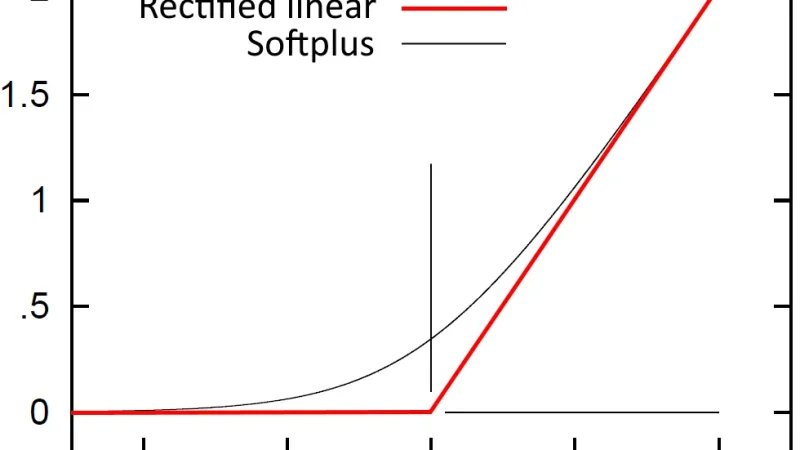
Leaky ReLU is a variant of the ReLU function that replaces zero for negative values with a small slope, keeping neurons from ever fully shutting down. This solves the dying neuron problem and improves training stability in deep neural networks, CNNs, and GAN discriminators.
4 min440
We use first- and third-party cookies to analyze site traffic. You can accept them, reject them, or configure your choice.
Learn more about cookies
Cookie preferences
NecessaryEssential for the site to work. Always on.
AnalyticsHelp us understand how the site is used (Google Analytics).