Vector databases have gone from an experimental curiosity to the central component of most LLM-based products. This comparison covers Qdrant, Pinecone, and Weaviate: architecture, strengths, limitations, and a decision tree for choosing the right option based on your operational priorities and budget.
With quantization, model weights are stored with fewer bits (4, 5, or 8 instead of 16), so Llama 2 13B shrinks from 26 GB to about 7.5 GB. With llama.cpp it runs on an ordinary 16GB-RAM laptop with no dedicated GPU, and the quality loss is smaller than intuition suggests.
LangChain is a Python framework that unifies building LLM applications: prompt templates, retrievers over vector databases, function-calling agents, and conversational memory. It earns its keep in fast prototypes and multi-model systems, but for a single well-defined production use case, direct code usually stays more maintainable.
A text embedding is a numeric vector that encodes the meaning of a word or phrase, so that semantically similar pieces of text produce nearby vectors measured by cosine distance. The models most used in production are OpenAI ada-002, Sentence Transformers, and BGE, and they mainly serve semantic search, RAG systems, and text classification without training a classic classifier.
Chroma is the easiest vector database to get started with embeddings and semantic search: install it with pip install chromadb, no extra infrastructure required, and it exposes a minimal API (add, query, delete). It suits prototypes and mid-sized RAG systems well; past a few million vectors, Qdrant or Milvus scale better.
Midjourney v5, released in March 2023, delivers consistent photorealism in skin, light, and depth of field, something v4 could not manage. The --style raw parameter disables the default artistic look, ideal for product photography. It still lacks an official API and only runs through Discord, so Stable Diffusion XL and DALL-E 3 remain more practical for automating pipelines.
In 2023, three frameworks address generative AI regulation differently: the EU AI Act sets four risk tiers with fines up to 6% of global turnover; the US NIST framework is voluntary; the UK delegates to sector regulators. Product teams should inventory AI use cases and document risks now.
Ollama makes it trivial to run models like Llama 2 or Mistral on your own computer: one binary, one command, and quantised weights downloading to disk with no compilation required. Covers installation on macOS, Linux, and Windows with an honest look at what local inference can and cannot do compared to frontier models.
Industrial predictive maintenance rarely needs deep learning: classic models such as random forests, SVMs, or survival models solve 80% of cases. The key lies in feature engineering over vibration, temperature, and power-consumption signals, with pipelines that run on as little as 50 MB of RAM without a GPU.
Five months after launch, GPT-4 excels at chained reasoning, technical writing, and medium-complexity code, but still fails at arithmetic, post-cutoff information, and cross-conversation consistency. Claude 2 wins on long context; LLaMA 2 wins on cost and privacy.
Meta released LLaMA 2 on July 18, 2023 with a royalty-free commercial licence, in three sizes (7B, 13B, 70B parameters). The 70B model matches or beats GPT-3.5 on standard benchmarks. For 99.9% of organisations the licence allows download, modification, and production use with full data privacy and no fine-tuning restrictions.
Google launched Bard in February 2023 with PaLM 2 as its answer to ChatGPT, unveiling the model in May the same year in four sizes: Gecko, Otter, Bison, and Unicorn. PaLM 2 competes with GPT-3.5 and GPT-4 on benchmarks like MMLU and BIG-bench, but Google's real edge is Workspace integration, not the model itself.
Fine-tuning your own LLM pays off in three cases: you need a very specific style or voice, a rigid structured output format, or you want lower cost and latency from a small specialised model. LoRA and QLoRA have cut the GPU cost, but preparing data and running the model in production are still expensive. For everything else, RAG and prompt engineering are usually enough.
Stable Diffusion XL marks a leap in open-licence image generation quality. What changes versus SD 1.5/2.1, the hardware requirements, and when to pick SDXL over Midjourney or DALL-E 3 for your workflow.
ChatGPT plugins let the model invoke external services through an OpenAPI specification. Three months after launch, the ecosystem has around 500 plugins with a clear pattern: they work well for live data lookup and internal API exposure, but show friction in multi-plugin orchestration and real-money transactions.
OpenAI Code Interpreter extends ChatGPT Plus with an isolated Python sandbox: it runs code on demand, reads files you upload (CSV, Excel, PDF, images, ZIPs) and returns results plus charts within the same chat. Sessions are ephemeral and offline, but remarkably effective for exploratory ad-hoc analysis without spinning up a notebook.
DINOv2 is Meta AI's computer vision model, trained via self-supervision on 142 million images with no human labels. With a simple linear layer on the frozen encoder, it matches or beats supervised models on ImageNet classification, semantic segmentation and monocular depth estimation.
Cerebras-GPT is a family of 7 open-source language models, ranging from 111 million to 13 billion parameters, trained by Cerebras Systems on its CS-2 processors with the standard GPT-3 architecture. Released on Hugging Face and GitHub under the Apache 2.0 license, they suit fine-tuning, research, and local inference, though they understand only English.
Qdrant is the pick when full control and performance in self-hosted setups matter most; Pinecone wins for fully managed SaaS with zero operations; Weaviate stands out when native embeddings and hybrid search built into one pipeline add real value. This comparison covers architecture, quantisation, filtering, and RAG use cases to help you decide based on budget and control needs.
The hyperbolic tangent (tanh) is an activation function that maps any real value to the interval (-1, 1) with zero-centred output, which makes it more stable than sigmoid in hidden layers. It is the standard in LSTM and GRU memory cells, though it shares with sigmoid the vanishing-gradient problem at extreme inputs.
The sigmoid function compresses any real value into the range (0, 1), making it the natural activation function for modelling probabilities in neural networks. It is differentiable everywhere, enabling training via backpropagation, though it suffers from saturation and vanishing gradients in deep layers, where ReLU and tanh have taken over.
The Softmax function converts a vector of logits (arbitrary values) into a probability distribution where every value is positive and the values sum to exactly 1. It is the standard output-layer activation for multi-class classification, and the final operation language models use to predict the next token.
Leaky ReLU is a variant of the ReLU function that replaces zero for negative values with a small slope, keeping neurons from ever fully shutting down. This solves the dying neuron problem and improves training stability in deep neural networks, CNNs, and GAN discriminators.
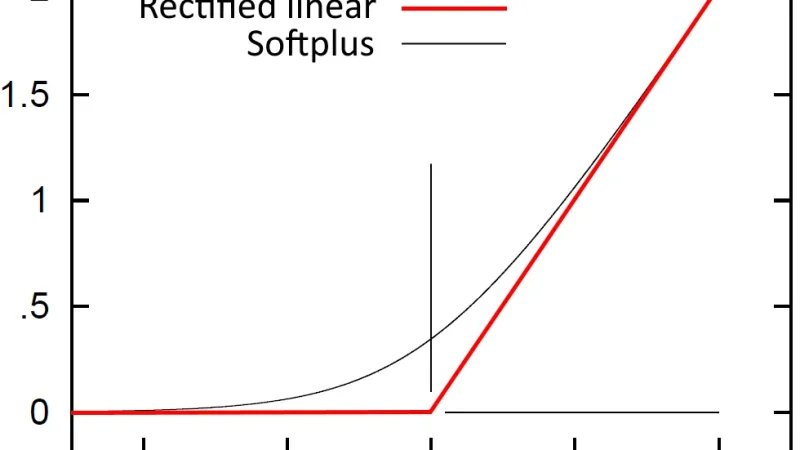
ReLU (rectified linear unit) is the most widely used activation function in deep neural networks: it returns the input value if positive, and zero if negative, defined as f(x) = max(0, x). Its low computational cost and resistance to the vanishing gradient problem that hampers sigmoid made it the de facto standard since AlexNet in 2012.
The step function, or Heaviside function, is the simplest activation function in neural networks: it converts any numeric input into a binary output, 0 or 1, depending on whether it crosses a fixed threshold. It was the central mechanism of Rosenblatt's 1958 perceptron, but because it is not differentiable, it cannot be used in modern backpropagation training.
The linear function, f(x) = ax + b, is the simplest activation a neural network can use: its output is directly proportional to the input, with no non-linear transformation. It is the standard choice for the output layer in regression problems, but in hidden layers it collapses the entire network into a single linear model, so it should never be used there.
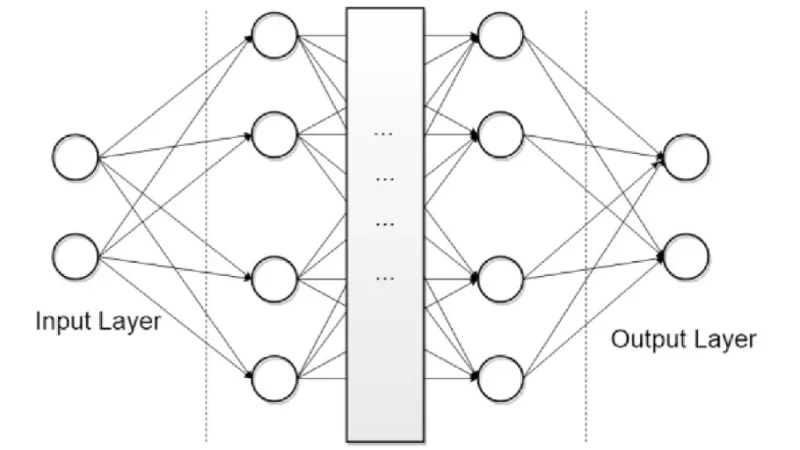
A fully connected neural network, also called a dense network, is the fundamental architecture of deep learning: every neuron in a layer connects to all neurons in the previous and next layer. This total connectivity lets it approximate any continuous function, though its computational cost grows quadratically with the number of neurons.
In a neural network, the input is represented as a column vector x in R^n that the hidden layer transforms through a weight matrix W, a bias vector b, and a non-linear activation function such as ReLU, sigmoid, or tanh. Training adjusts W and b by minimising the loss function via gradient descent and backpropagation.
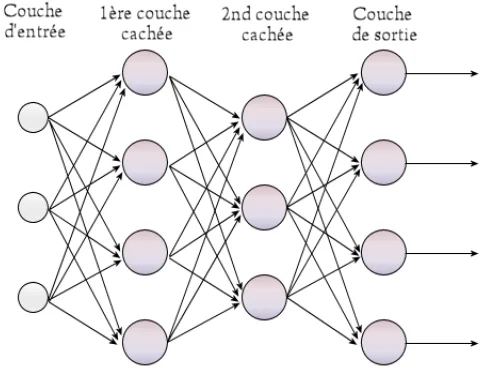
A multilayer neural network consists of an input layer, one or more hidden layers, and an output layer, where each neuron weights its inputs and applies a non-linear activation function before passing the result to the next layer. Through forward propagation and backpropagation, the network adjusts millions of weights to learn hierarchical representations capable of classifying images, translating text, or generating language.
Spark DataFrames are distributed, schema-based tables that the Catalyst engine optimises automatically, while pipelines chain those transformations into a reproducible end-to-end flow. Together they let you process large data volumes efficiently across a cluster, scaling from a laptop to hundreds of nodes without rewriting code.
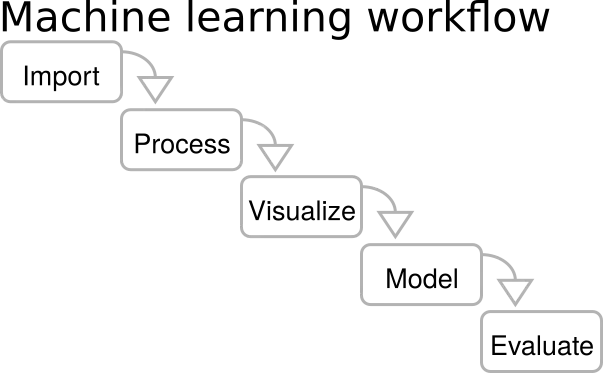
LazyPredict is a Python library that automatically evaluates dozens of scikit-learn classification and regression models on your dataset in seconds, without writing training code for each one. LazyClassifier and LazyRegressor return a comparative metrics table that shows which models are worth tuning further.
AI optimises B2B sales through four levers: predictive lead scoring that prioritises the buyers most likely to close, conversation analysis, at-scale outreach personalisation and automating repetitive tasks. Its real impact depends on starting from clean CRM data.
ChatGPT 4 combines advanced natural language processing with deep learning to deliver conversations that are more natural, coherent, and personalised than earlier chatbots. It understands intent and accumulated context, handles multiple intents in a single turn, and reduces escalations to human agents, though it still requires careful design and human oversight.
Federated learning trains AI models collaboratively across many devices or organisations without moving the original data: each participant trains locally and sends only gradients to the central server. Formalised by Google in 2016, it does not guarantee privacy on its own: it needs differential privacy or secure aggregation to prevent leaks from those gradients.
Recommendation systems are the invisible engine behind Netflix, Amazon, and Spotify. Collaborative filtering predicts individual preferences by analysing the behaviour of millions of users without examining item content: 80% of what Netflix viewers watch and 35% of Amazon sales come from algorithmic recommendations.
Explainable AI (XAI) is the set of techniques that open the black box of AI models and answer why they made a given decision. Methods such as LIME, SHAP and Grad-CAM activation maps are the most widely used. Its adoption is mandatory in regulated environments: healthcare, justice, and financial services.
Reinforcement learning is the AI technique in which an agent learns to make optimal decisions through trial and error, without labelled data: it acts in an environment, receives a reward or penalty based on the outcome, and adjusts its strategy to maximise long-term cumulative reward.
Intelligent automation combines AI, machine learning, and physical robots that perceive, decide, and adapt in real time instead of following a fixed script. It is transforming manufacturing, logistics, healthcare, and food processing, and by 2024 there were already more than 4.6 million industrial robots active worldwide, per the IFR.
Computer vision is the branch of artificial intelligence that lets machines interpret digital images: detecting objects, segmenting regions and recognising patterns through convolutional neural networks. Since 2012, when AlexNet cut ImageNet classification error to 15.3%, it has spread into manufacturing, medicine, transport and precision agriculture.
Natural Language Processing (NLP) is the AI discipline that enables machines to understand, interpret, and generate human text and speech. Powered by the transformer architecture since 2017, NLP drives chatbots, automatic translation, and clinical diagnosis tools, with open challenges in causal reasoning, energy efficiency, and bias mitigation.
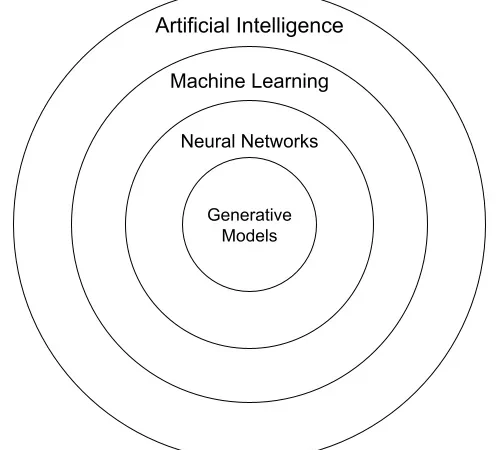
Deep neural networks are today the foundation of almost every artificial intelligence application: from facial recognition to machine translation. Built on architectures like CNNs, RNNs, and Transformers, deep learning has transformed computer vision, speech recognition, and natural language processing over the last decade.
4 min2044.4
We use first- and third-party cookies to analyze site traffic. You can accept them, reject them, or configure your choice.
Learn more about cookies
Cookie preferences
NecessaryEssential for the site to work. Always on.
AnalyticsHelp us understand how the site is used (Google Analytics).