n8n 3.0 is not out yet: n8n plans it for October 2026 and the stable release is 2.39.6. To prepare a Docker install, open Settings > Migration Report, replace the removed nodes, pin the defaults that change, move binaryData to storage and try the v3-nightly image on a copy.
n8n is not open source: its Sustainable Use License limits you to your own internal business purposes and forbids charging people to access a hosted instance. Activepieces publishes its core under MIT but keeps agents, projects and API access outside it. Windmill compiles to AGPLv3 from source, yet the distributed Community Edition is not open.
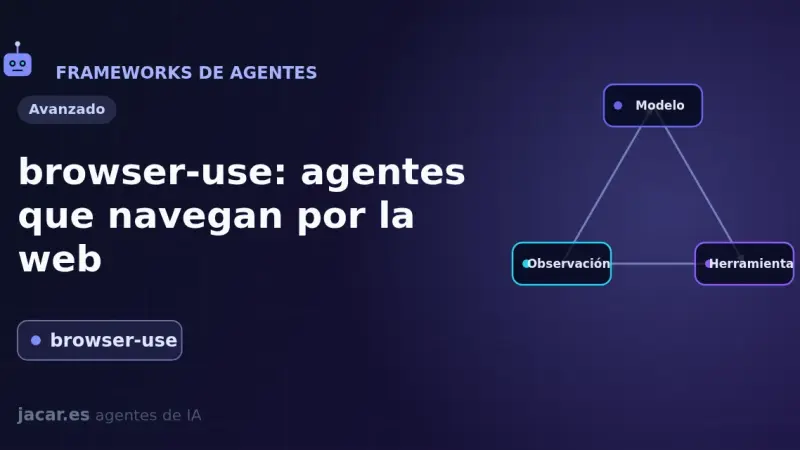
browser-use is an open-source Python library that lets an AI agent drive a web browser the way you do: it opens pages, reads the DOM, clicks and fills in forms. It was born on Playwright and in 2025 switched to speaking Chrome's CDP protocol directly for speed. This guide explains how it works and when to use it.
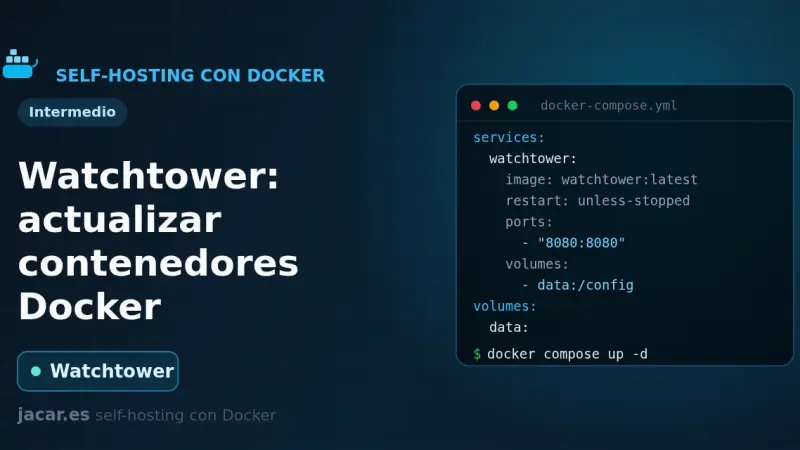
Watchtower is a container that watches your Docker registries, detects when a newer image is available, pulls it and recreates your container with the same options. You configure it with a small docker-compose.yml, it polls every 24 hours by default, and you can restrict it with labels or keep it in notify-only mode.
Cobots have been promising the fenceless factory for almost fifteen years. In 2026, with the market heading toward eleven billion dollars and 70% of orders coming from outside automotive, it is time to review what has delivered and what remains open.
Prompt engineering has moved from viral tricks to a discipline with reproducible patterns: few-shot, chain-of-thought, and structured output with function calling. Teams treating prompts like code (versioned, tested, and monitored) get consistently better results than those who improvise.
Humanoid robotics left the trade-show floor for factory floors and warehouses during 2025 and 2026. Which companies have really deployed units, which tasks fit, what real costs look like, and where humans remain unbeatable.
Sixteen months after Anthropic first shipped computer use, with browser-use, OpenAI Operator and Gemini Computer Use all pushing in parallel, agents that drive the browser and desktop have moved from demo to real workflows. Time to review which patterns survive when you run them daily in production.
Large language models have spent two years promising effortless documentation for code, APIs and architecture. After watching dozens of projects try it, clear patterns emerge for where it works and where it just becomes more debt.
n8n is the low-code automation project that has best adapted to self-hosting. A walk through the real install with Docker Compose, the database and queue decisions to make, and the points where most people trip up the first time.
Computer Use in production works today for narrow, repetitive interface tasks where a human still checks the result. Anthropic shipped it in October 2024 calling it experimental and error-prone, and nine months on that framing still holds: teams run it on real work by constraining scope, not by trusting it end to end.
AI agents are starting to earn a real place in continuous integration pipelines: reviewing diffs, proposing fixes, generating missing tests. Six months of real-world use to separate the patterns that work from the ones that end up costing more time than they save.
AI agents have moved from a lab curiosity to serious SDKs from three major providers. A reflection on moving from the flashy demo to an internal use case that shifts a real, measurable metric.
Computer Use is the Claude API feature, launched by Anthropic on 22 October 2024, that lets the model view screenshots and move the mouse, type, and click inside a loop your own system executes and controls. It works well on apps without an API and fails on CAPTCHAs, highly dynamic interfaces, and long tasks.
Ansible and Pulumi solve different problems and are not competitors: Ansible manages configuration inside a server (packages, users, services); Pulumi defines, with real code in TypeScript, Python, Go or .NET, which cloud infrastructure exists (VPCs, instances, databases). Combining them, with Pulumi's dynamic inventory feeding Ansible, is the most productive pattern for automating a stack that includes servers in the cloud.
Semaphore is the open-source Ansible web UI that solves the four scaling problems: audit trails, role-based permissions, execution history, and centralised secrets. It consumes ~500 MB versus AWX at ~4 GB. The pragmatic choice for mid-size teams that have outgrown running playbooks from a shared terminal.
Without sensors generating reliable data, Industry 4.0 is just marketing. The foundation of any real project is instrumenting machines and production lines with temperature, vibration, pressure, and flow sensors, connecting them via Modbus, OPC-UA, or MQTT through a gateway, and starting with 5-10 sensors on a pilot line before buying at scale.
The best RPA tools on the market are UiPath, Automation Anywhere, and Blue Prism, the three share leaders, followed by WorkFusion, Kofax, NICE RPA, Pegasystems, EdgeVerve AssistEdge, Redwood Software, and Microsoft Power Automate. The right platform depends on organisation size, the AI capabilities needed, and two-year total cost of ownership.
Intelligent automation combines AI, machine learning, and physical robots that perceive, decide, and adapt in real time instead of following a fixed script. It is transforming manufacturing, logistics, healthcare, and food processing, and by 2024 there were already more than 4.6 million industrial robots active worldwide, per the IFR.
Industry 4.0 is the Fourth Industrial Revolution: the convergence of IoT, artificial intelligence, big data, advanced robotics, and cybersecurity that connects factories to digital networks. The goal is the smart factory, able to adjust its production in real time from the data it collects, gaining productivity, quality, and energy efficiency.
5 min1944.5
We use first- and third-party cookies to analyze site traffic. You can accept them, reject them, or configure your choice.
Learn more about cookies
Cookie preferences
NecessaryEssential for the site to work. Always on.
AnalyticsHelp us understand how the site is used (Google Analytics).