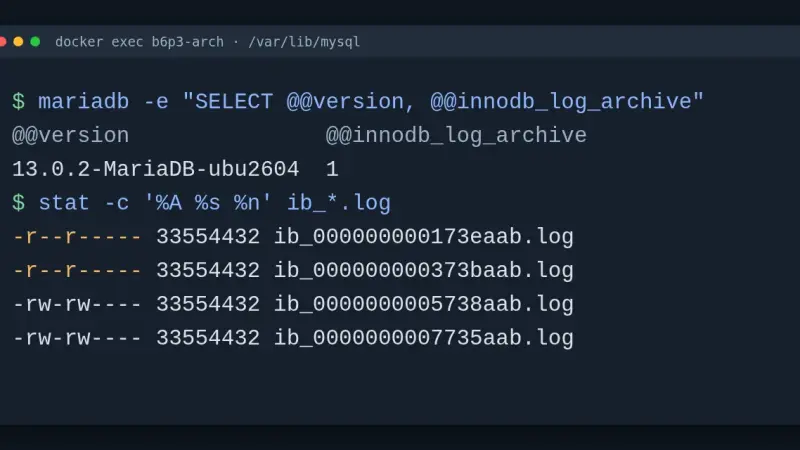
MariaDB 13.0.2, stable since 15 September 2026, is a rolling release with community support until Q4 2026, not an LTS. It adds redo log archiving, UPDATE with RETURNING and implicit query block names for hints. I upgraded in Docker from 12.3 and 11.8: the server starts, but mariadb-upgrade misses broken stored routines.
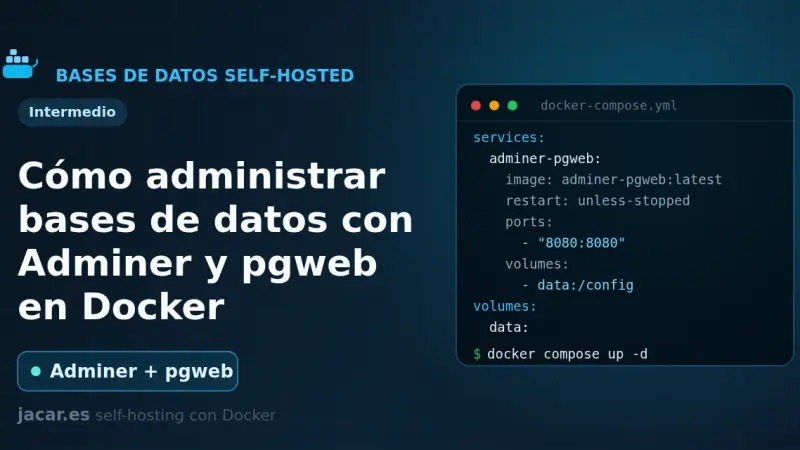
Adminer and pgweb are two web-based database managers that run in Docker with a single container each. Adminer is one PHP file that handles MySQL, PostgreSQL and six other engines; pgweb is a Go explorer dedicated to PostgreSQL. This guide brings a ready-to-copy docker-compose.yml and explains how to secure them properly.
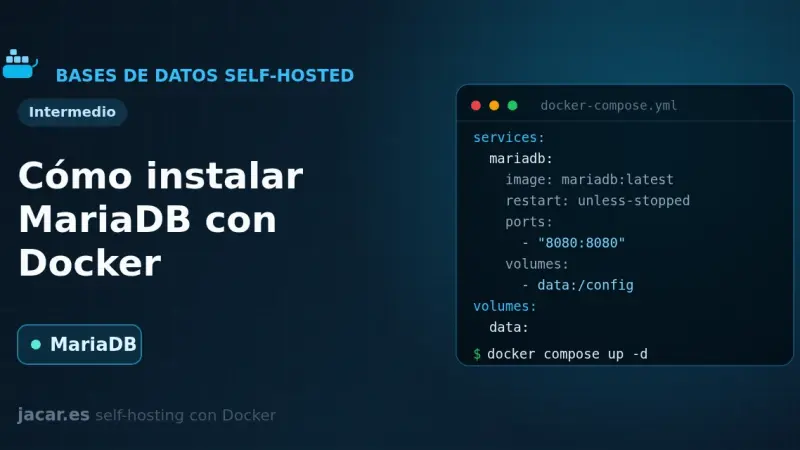
MariaDB is an open-source relational database, a fork of MySQL and compatible with it, that in Docker runs as a single container with a persistent volume. With this docker-compose.yml you set the root password, the database and the initial user through environment variables, and you keep your data even if you recreate the container.
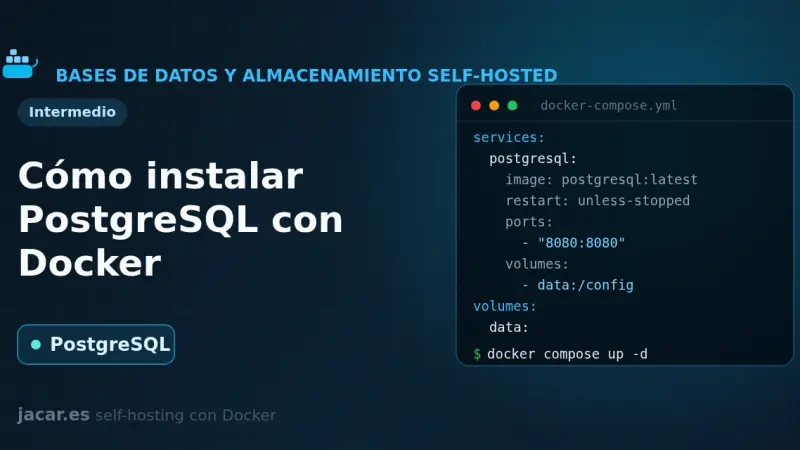
PostgreSQL, which its own project calls the most advanced open-source relational database, comes up in Docker with a single docker-compose.yml file. You define a persistent volume at the path version 18 expects, the superuser password and a pg_isready healthcheck, and within seconds you have a server on port 5432 ready for other containers to connect to it by the service name.
TigerBeetle is a distributed database written in Zig, specialized in one specific kind of workload: high-volume double-entry accounting with strong consistency guarantees. It does not aim to replace Postgres; it aims to be the right tool when the problem is counting financial transactions at millions per second without subtle failures.
SQLite in production is a sound choice for small and mid-sized web applications once WAL mode is enabled, since concurrency on typical web loads improves by roughly two orders of magnitude. Litestream streams the WAL to S3-compatible object storage for point-in-time restore, and NVMe disks on cheap VPS plans removed the old disk objection.
Dragonfly is a Redis-protocol-compatible cache built on a multithreaded shared-nothing design with one thread per data shard, so an eight-core node uses all eight cores where Redis uses one. Its fork-free snapshot algorithm keeps latency flat while persisting. Ordinary clients work fine; modules like RedisSearch and RedisJSON are where compatibility frays.
Redpanda promises Kafka-protocol compatibility without the JVM, without ZooKeeper, and with a thread-per-core architecture. By 2025 there are already serious production deployments. It is worth understanding where the switch pays off and where it does not.
Redis 8.2 ships vector search as a native data type. The real question is whether it replaces a dedicated engine like Qdrant, Weaviate, or pgvector on workloads with millions of vectors and tight latency budgets, or only works as a bonus on top of the cache you already run.
MariaDB 11.7 (November 2024) adds native vector search with an HNSW index, JSON improvements via JSON_OBJECT_AGG, and 5-15% faster read workloads versus 11.5. Against MySQL 8, the edge is not depending on HeatWave for embeddings; against PostgreSQL, it still trails on JSON depth and data types.
SQLite and DuckDB are both embedded databases that work from a single file, no server needed. Their architecture differs: SQLite stores rows and excels at short transactions (OLTP); DuckDB stores columns and shines at large-scale analytics (OLAP). Choosing the right one, or combining both, delivers a genuine technical edge.
PostgreSQL 16, released in September 2023, adds logical replication from a standby, the pg_stat_io view for breaking down I/O by operation type and context, and parallel FULL OUTER JOIN support. Upgrading from 15 is straightforward; 13 loses support in November 2025, so plan the update soon.
6 min2424.3
We use first- and third-party cookies to analyze site traffic. You can accept them, reject them, or configure your choice.
Learn more about cookies
Cookie preferences
NecessaryEssential for the site to work. Always on.
AnalyticsHelp us understand how the site is used (Google Analytics).