Computer Use is the Claude API feature, launched by Anthropic on 22 October 2024, that lets the model view screenshots and move the mouse, type, and click inside a loop your own system executes and controls. It works well on apps without an API and fails on CAPTCHAs, highly dynamic interfaces, and long tasks.
GitHub Copilot Workspace, in technical preview since April 2024, proposes task-oriented development: describe the problem in a GitHub issue and the AI reads the codebase, generates an editable multi-file plan, and implements it. It competes with Cursor Composer, though with more latency; its edge is native integration with PRs, issues, and GitHub history.
OpenAI published Swarm as an experimental, educational framework for multi-agent systems. It reduces coordination to two concepts — agents and handoffs — and fits in under 500 lines of Python. A comparison with CrewAI and LangGraph.
vLLM serves language models on GPU using PagedAttention and continuous batching, two techniques that multiply throughput compared with a naive server. It exposes an OpenAI-compatible API, so migrating an existing application only requires changing the base URL and deploying the right binary.
OpenAI's Assistants API offers persistent threads, sandboxed code execution, and managed document search, but OpenAI is shutting it down completely on August 26, 2026 in favor of the Responses API. We look at when it used to pay off against Chat Completions with your own infrastructure, and what to do if your project still depends on it.
Installing Ollama on an Apple Silicon Mac is as simple as running one Homebrew command. Then pick a model based on available RAM (Phi-3 for 8 GB, Llama 3.1 8B for 16 GB) and expose the local, OpenAI-compatible HTTP API on port 11434 to plug it into your own applications.
GitLab Duo brings native AI into the whole devops flow: code completion, chat, MR summaries and vulnerability explanation. Duo Pro costs 19 dollars per user monthly on top of Premium or Ultimate, the same as GitHub Copilot Business. It pays off when your team already lives in GitLab.
SGLang adds a Python DSL for controlling LLM generation with constrained decoding, parallel branching, and RadixAttention, the structure that indexes the KV cache as a radix trie to reuse shared prefixes across requests. When that pattern exists, speedups over vLLM reach up to 5 times; without it, the advantage shrinks.
Llama 3 is the open-model family Meta released on April 18, 2024, in 8-billion and 70-billion-parameter sizes, trained on 15 trillion tokens. The 70B beat Claude Sonnet, Mistral Medium, and GPT-3.5 in Meta's own human evaluation, and its licence allows free commercial use up to 700 million monthly active users.
nomic-embed-text-v1.5 from Nomic AI is an embedding model with weights, code and training data released under Apache 2.0: 137 million parameters, up to 8192 tokens of context, and an MTEB score of 62.4, almost matching the 62.3 of OpenAI's text-embedding-3-small, at 768 dimensions instead of 1536.
LangGraph modela agentes LLM como grafos de estados explícitos. Cuándo supera al bucle tradicional de LangChain y cómo estructurar flujos que no se desmoronan en producción.
Cuando una aplicación habla con dos o más proveedores de LLM, antes o después aparece un proxy entre medias. LiteLLM propone uno concreto, y esta es la lectura honesta de qué gana y qué cuesta.
Gemini 1.5 Pro launched in February 2024 with a verified one-million-token context window. It retrieves over 95% of data up to 530,000 tokens in recall tests, reshaping RAG system design, making full-document analysis viable, and enabling new architectural patterns through context caching.
Choosing an open LLM for enterprise in 2024 is no longer just Llama 2: Mistral, Mixtral, Qwen, Yi, DeepSeek, and Phi-2 all compete with different licences and sizes. The criteria that actually decide are commercial licence, available hardware, language support, and your own evaluation on real use cases, not just the trendy benchmark.
pgvector matured in 2023-2024 with the HNSW index type and parallel construction that arrived in version 0.6. For projects already running PostgreSQL, a dedicated vector database is not needed in most cases: this guide explains when PostgreSQL is enough, how to configure the index, and where it starts to fall short.
Cohere Embed v3 is an embedding model that distinguishes queries from documents via the input_type parameter and scores intrinsic text quality, with multilingual support for over 100 languages at 1024 dimensions. It costs $0.10 per million tokens versus OpenAI's $0.02, and delivers better recall in multilingual RAG.
Text Generation Inference (TGI) is the Hugging Face stack for serving open LLMs in production: continuous batching, 4-bit and 8-bit quantization, streaming, and an OpenAI-compatible API. After a brief restrictive-licence episode in 2023, it returned to Apache 2.0 in version 2.0.
Vector databases have gone from an experimental curiosity to the central component of most LLM-based products. This comparison covers Qdrant, Pinecone, and Weaviate: architecture, strengths, limitations, and a decision tree for choosing the right option based on your operational priorities and budget.
LangChain is a Python framework that unifies building LLM applications: prompt templates, retrievers over vector databases, function-calling agents, and conversational memory. It earns its keep in fast prototypes and multi-model systems, but for a single well-defined production use case, direct code usually stays more maintainable.
Chroma is the easiest vector database to get started with embeddings and semantic search: install it with pip install chromadb, no extra infrastructure required, and it exposes a minimal API (add, query, delete). It suits prototypes and mid-sized RAG systems well; past a few million vectors, Qdrant or Milvus scale better.
Midjourney v5, released in March 2023, delivers consistent photorealism in skin, light, and depth of field, something v4 could not manage. The --style raw parameter disables the default artistic look, ideal for product photography. It still lacks an official API and only runs through Discord, so Stable Diffusion XL and DALL-E 3 remain more practical for automating pipelines.
In 2023, three frameworks address generative AI regulation differently: the EU AI Act sets four risk tiers with fines up to 6% of global turnover; the US NIST framework is voluntary; the UK delegates to sector regulators. Product teams should inventory AI use cases and document risks now.
Ollama makes it trivial to run models like Llama 2 or Mistral on your own computer: one binary, one command, and quantised weights downloading to disk with no compilation required. Covers installation on macOS, Linux, and Windows with an honest look at what local inference can and cannot do compared to frontier models.
Industrial predictive maintenance rarely needs deep learning: classic models such as random forests, SVMs, or survival models solve 80% of cases. The key lies in feature engineering over vibration, temperature, and power-consumption signals, with pipelines that run on as little as 50 MB of RAM without a GPU.
Stable Diffusion XL marks a leap in open-licence image generation quality. What changes versus SD 1.5/2.1, the hardware requirements, and when to pick SDXL over Midjourney or DALL-E 3 for your workflow.
Qdrant is the pick when full control and performance in self-hosted setups matter most; Pinecone wins for fully managed SaaS with zero operations; Weaviate stands out when native embeddings and hybrid search built into one pipeline add real value. This comparison covers architecture, quantisation, filtering, and RAG use cases to help you decide based on budget and control needs.
The hyperbolic tangent (tanh) is an activation function that maps any real value to the interval (-1, 1) with zero-centred output, which makes it more stable than sigmoid in hidden layers. It is the standard in LSTM and GRU memory cells, though it shares with sigmoid the vanishing-gradient problem at extreme inputs.
The sigmoid function compresses any real value into the range (0, 1), making it the natural activation function for modelling probabilities in neural networks. It is differentiable everywhere, enabling training via backpropagation, though it suffers from saturation and vanishing gradients in deep layers, where ReLU and tanh have taken over.
The Softmax function converts a vector of logits (arbitrary values) into a probability distribution where every value is positive and the values sum to exactly 1. It is the standard output-layer activation for multi-class classification, and the final operation language models use to predict the next token.
The linear function, f(x) = ax + b, is the simplest activation a neural network can use: its output is directly proportional to the input, with no non-linear transformation. It is the standard choice for the output layer in regression problems, but in hidden layers it collapses the entire network into a single linear model, so it should never be used there.
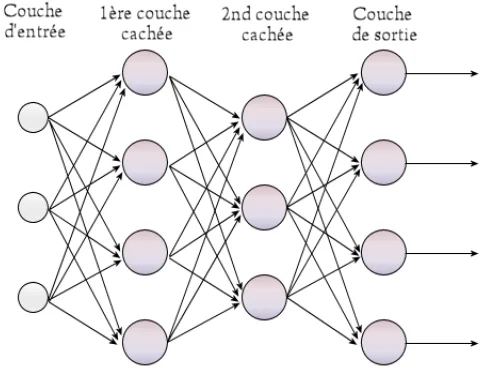
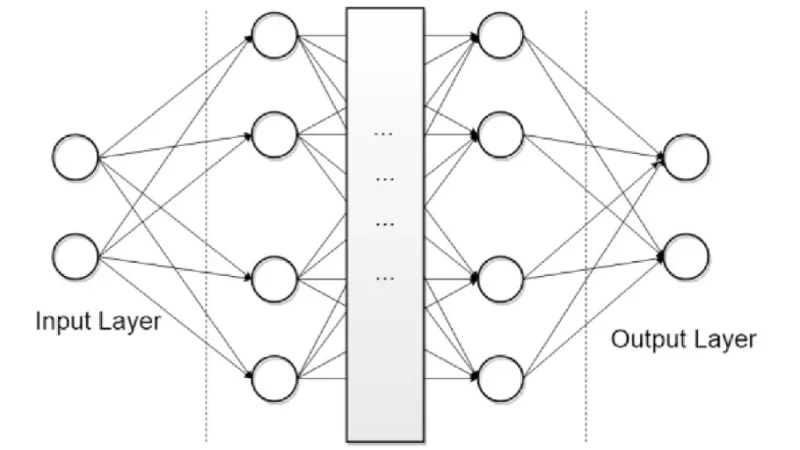
A fully connected neural network, also called a dense network, is the fundamental architecture of deep learning: every neuron in a layer connects to all neurons in the previous and next layer. This total connectivity lets it approximate any continuous function, though its computational cost grows quadratically with the number of neurons.
In a neural network, the input is represented as a column vector x in R^n that the hidden layer transforms through a weight matrix W, a bias vector b, and a non-linear activation function such as ReLU, sigmoid, or tanh. Training adjusts W and b by minimising the loss function via gradient descent and backpropagation.
A multilayer neural network consists of an input layer, one or more hidden layers, and an output layer, where each neuron weights its inputs and applies a non-linear activation function before passing the result to the next layer. Through forward propagation and backpropagation, the network adjusts millions of weights to learn hierarchical representations capable of classifying images, translating text, or generating language.
Spark DataFrames are distributed, schema-based tables that the Catalyst engine optimises automatically, while pipelines chain those transformations into a reproducible end-to-end flow. Together they let you process large data volumes efficiently across a cluster, scaling from a laptop to hundreds of nodes without rewriting code.
ChatGPT 4 combines advanced natural language processing with deep learning to deliver conversations that are more natural, coherent, and personalised than earlier chatbots. It understands intent and accumulated context, handles multiple intents in a single turn, and reduces escalations to human agents, though it still requires careful design and human oversight.
Transfer learning lets you reuse a model already trained on a massive dataset, such as ImageNet or a large text corpus, to solve a new task with far less proprietary data and compute time. It works through fine-tuning, feature extraction, or prompting, and it performs best when the source and target domains are similar to each other.
Adversarial machine learning studies deliberate attacks on AI systems (evasion, poisoning and model extraction) and the defenses used to resist them, chiefly adversarial training, robustness certification and monitoring the distribution of production input data.
Recommendation systems are the invisible engine behind Netflix, Amazon, and Spotify. Collaborative filtering predicts individual preferences by analysing the behaviour of millions of users without examining item content: 80% of what Netflix viewers watch and 35% of Amazon sales come from algorithmic recommendations.
Explainable AI (XAI) is the set of techniques that open the black box of AI models and answer why they made a given decision. Methods such as LIME, SHAP and Grad-CAM activation maps are the most widely used. Its adoption is mandatory in regulated environments: healthcare, justice, and financial services.
Reinforcement learning is the AI technique in which an agent learns to make optimal decisions through trial and error, without labelled data: it acts in an environment, receives a reward or penalty based on the outcome, and adjusts its strategy to maximise long-term cumulative reward.
Deep neural networks are today the foundation of almost every artificial intelligence application: from facial recognition to machine translation. Built on architectures like CNNs, RNNs, and Transformers, deep learning has transformed computer vision, speech recognition, and natural language processing over the last decade.
4 min2104.4
We use first- and third-party cookies to analyze site traffic. You can accept them, reject them, or configure your choice.
Learn more about cookies
Cookie preferences
NecessaryEssential for the site to work. Always on.
AnalyticsHelp us understand how the site is used (Google Analytics).