
Learning path Advanced
AI Agents in Production: Evaluation and Reliability
What makes an agent reliable: observability with Langfuse and Helicone, evaluation with DeepEval and promptfoo, prompt caching to cut costs, sandboxing with E2B, containerized deployment and durable execution with Temporal.
- 10 resources
- 15 views
- ~105 min
This advanced path teaches you to take an AI agent from prototype to a reliable production system: how to observe what it does, measure whether it gets things right, control its cost, and isolate its execution before shipping it. It is built for people who already have a working agent and need to make it trustworthy at scale.
What you’ll be able to do
By the end you’ll know how to instrument agent traces with self-hosted tooling, design automated evaluations that catch regressions before they reach production, cut token costs with prompt caching, and run model-generated code in an isolated sandbox. This is advanced-level: it assumes you already work with LLMs and agent frameworks and want to move past “it works on my machine” toward a system you can actually operate with confidence.
How the sequence builds
It starts with observability: Langfuse for self-hosted tracing and Helicone for instrumenting any provider with a single line of code. With that visibility in place, the next block covers evaluation, where DeepEval supplies automated metrics and promptfoo adds regression testing for prompts and agents. Before touching cost and safety, the path covers prompt caching to cut the token bill on repeated calls, then E2B as a sandbox where the agent can run code without putting the host at risk. It closes with actually deploying the agent in a container and running long workflows durably with Temporal, which survives restarts and partial failures. Each stop solves a concrete problem that shows up once an agent grows past a demo.
Langfuse: self-hosted agent observability
Langfuse is an open-source platform to observe, debug and evaluate AI applications and agents. You can self-host it with Docker Compose on Postgres, ClickHouse, Redis and S3 storage, and its Python SDK, built on OpenTelemetry, captures traces, spans and generations with their cost and latency. This guide explains how to deploy it and instrument an agent.
Helicone: LLM observability in one line
Helicone is an open-source LLM observability platform you integrate by changing a single line: your client's base URL. It logs cost, latency and tokens for every call, adds caching and rate limiting, and you can self-host it with Docker. It is Apache-2.0 and has nearly 6,000 GitHub stars, though since March 2026 it sits in maintenance mode.
DeepEval: evaluating AI agents
DeepEval is the open-source framework for evaluating AI systems as if you were writing Pytest tests: you define cases, pick research-backed metrics (G-Eval, faithfulness, tool correctness) and get a score from 0 to 1 that passes or fails each response, both on your machine and in continuous integration.
promptfoo: testing prompts and agents
promptfoo is an open-source tool to test and evaluate prompts, agents and RAG systems with declarative YAML configs. It compares models like GPT, Claude or Gemini in one matrix, scores answers with automatic assertions and adds red teaming with over fifty vulnerability types. It plugs into your CI, and OpenAI acquired it in March 2026.
ThinkingBox: checking whether your agent does real work
ThinkingBox is an MIT-licensed Microsoft sandbox that runs an agent against stateful MCP tools and judges it by the side effects it leaves in the system, not by what it claims to have done. Its companion benchmark covers 507 business tasks, each repeated twenty times.
Agent Lightning: reinforcement learning for agents without rewriting them
Agent Lightning is the Microsoft Research framework that applies reinforcement learning to the model behind an agent you already wrote. The agent points its OpenAI client at the Agent Lightning proxy instead of the model, and the proxy records requests, responses and rewards while the agent keeps its tools and control flow.
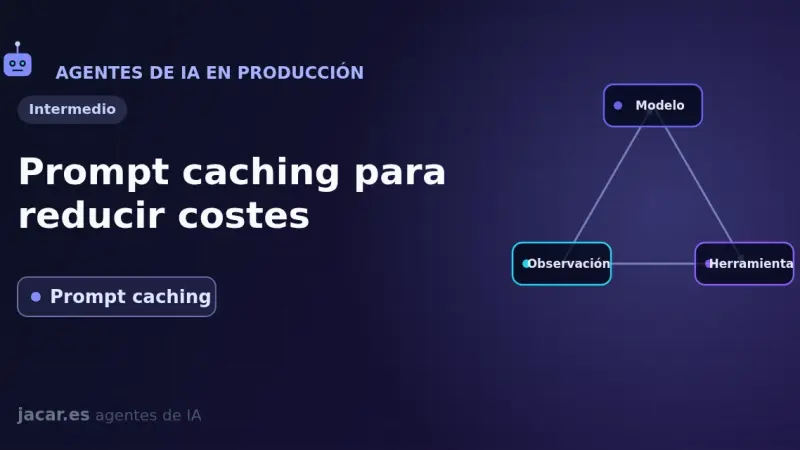
Prompt caching to cut costs
Prompt caching stores the stable prefix of your prompt (instructions, documents, tools) so it isn't reprocessed on every call. Anthropic and Gemini discount those tokens by up to 90%; OpenAI discounts by 50% on classic models and up to 90% on GPT-5.6. This guide covers each provider, how to structure the prompt, and how to cache on your own machine with vLLM.
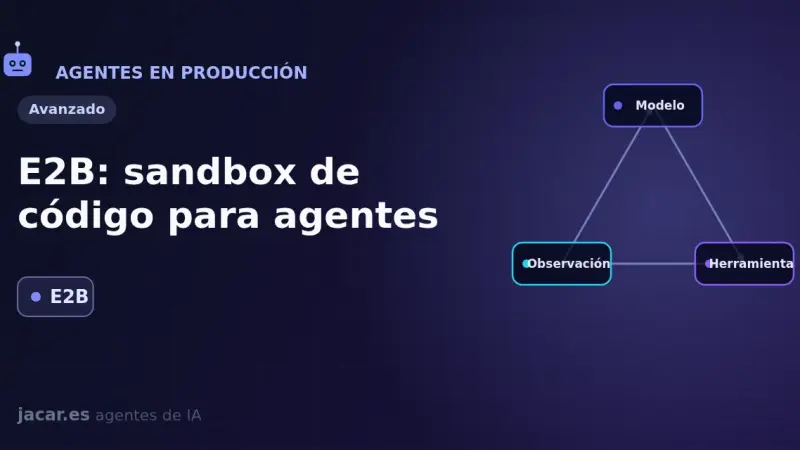
E2B: a code sandbox for agents
E2B is open-source infrastructure that runs your agent's generated code inside isolated Firecracker microVMs, each with its own Linux kernel. It boots in about 150 ms, exposes a stateful interpreter from its Python SDK and can be self-hosted with Terraform. This guide explains why an agent needs a sandbox and how to use E2B.
Deploying an AI Agent to Production
Deploying an AI agent to production means turning your local script into a containerised service, with external state, observability and managed secrets. In this guide you package an agent inside a minimal Docker image, expose an HTTP endpoint with FastAPI and add health checks, retries and rate limits so it survives real traffic.
Durable Agent Execution with Temporal
Durable execution lets an AI agent survive crashes, restarts and API rate limits without losing its progress. Temporal applies this model: your logic lives in a workflow that resumes exactly where it stopped, and every model or tool call runs as an activity that Temporal retries for you automatically on failure.