The Kano Model: Improving Customer Satisfaction
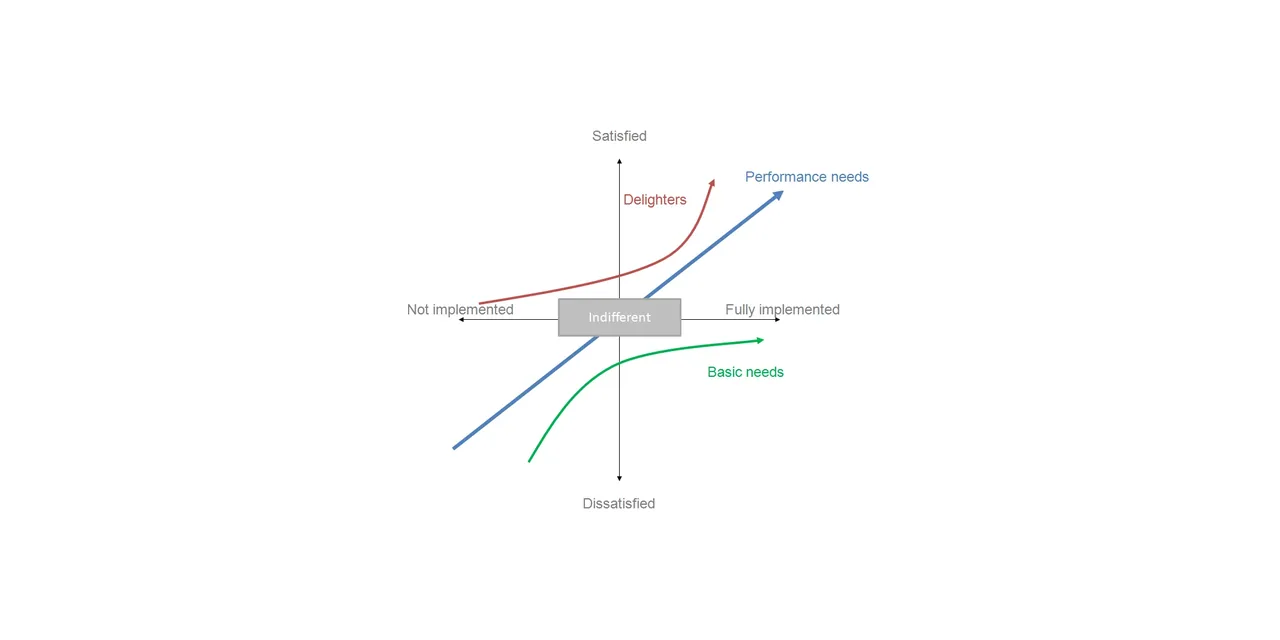
Table of contents
- Key takeaways
- The three need categories
- The visual model
- How to Run a Kano Survey
- Applications in product strategy
- Temporal dynamics: features that age
- Conclusion
- Frequently asked questions
- How is each feature classified in a Kano survey?
- Can I discover emotional features by directly asking customers what they want?
- Does a feature classified as a delighter stay that way forever?
The Kano model answers a question product teams ask constantly: which product features have the most impact on customer satisfaction? The answer is not always intuitive, and Noriaki Kano’s framework offers a structure for separating what customers expect in silence, what they value explicitly, and what delights them unexpectedly.
Key takeaways
-
Kano classifies product features into three categories: basic (threshold), performance (linear), and emotional (delighters).
-
Basic features do not generate satisfaction; only their absence generates dissatisfaction.
-
Emotional features cannot be identified by directly asking the customer: they require observation and testing.
-
An emotional feature today can become a basic one tomorrow as the industry adopts it.
-
The model is most useful at the start of product design rather than as a late validation tool.
The three need categories
Basic needs (Must-be / Threshold) Features the customer takes for granted. Their presence generates no satisfaction: the customer does not mention them because they are assumed. Their absence, however, generates strong dissatisfaction.
Example: a banking app not losing transactions, a hotel having hot water, e-commerce software processing payments correctly.
Performance needs (One-dimensional) Features where more investment equals more satisfaction, linearly. Customers mention these explicitly in surveys and comparisons. They are the competitive battleground.
Example: web page load speed, mobile battery life, classification model accuracy, SaaS service pricing.
Emotional needs (Attractive / Delighters) Features the customer does not expect but that, when present, produce disproportionate satisfaction. Their absence generates no dissatisfaction; the customer did not know they needed them. They are sources of differentiation and positive word of mouth.
Example: unexpectedly good offline mode in an app, surprising product packaging, unlimited undo in an editor.
The visual model
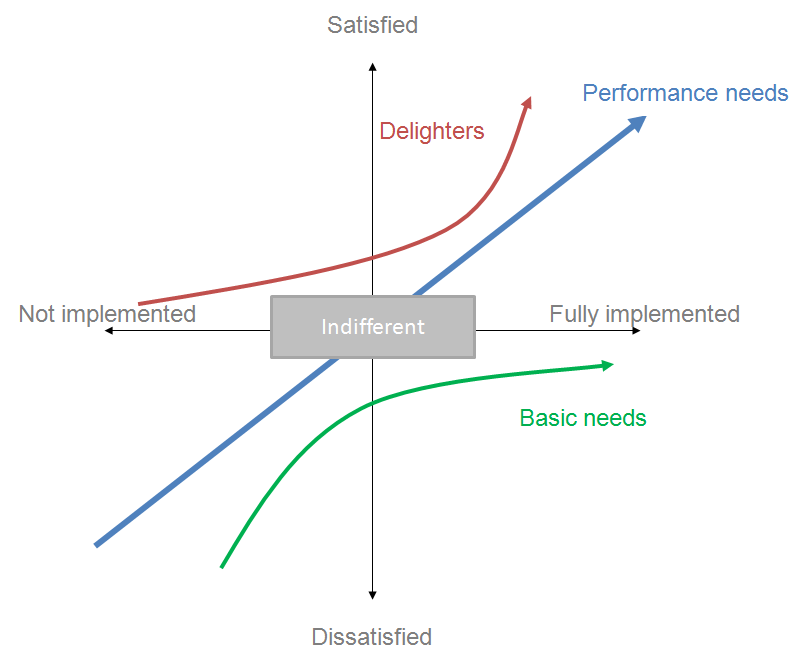 Kano model diagram with customer satisfaction and functionality degree axes, showing curves for basic, performance, and emotional needs (Image: Craigwbrown, CC BY-SA 3.0, via Wikimedia Commons)
The horizontal axis represents the degree of feature implementation (from absent to fully implemented). The vertical axis represents customer satisfaction (from frustration to delight). The three curves show how each type of need responds differently to the same investment axis.
How to Run a Kano Survey
The standard process combines two questions per feature:
-
Functional question: "If the product has this feature, how do you feel?" (options: I love it / I expect it / I am neutral / I can accept it / I dislike it)
-
Dysfunctional question: "If the product does not have this feature, how do you feel?" (same options)
The combination of answers allows classifying each feature using the Kano classification table. For example, if a customer says "I love it" when the feature exists and "I don’t care" when it does not, the feature is Attractive (emotional).
The complete steps:
-
Define the list of features to evaluate (ideally 10-20; more creates survey fatigue).
-
Design the functional and dysfunctional questions for each feature.
-
Distribute the survey to a representative sample of customers.
-
Classify each feature using the Kano classification table.
-
Prioritise the roadmap based on the distribution: protect basics, invest in performance features, and experiment with emotional ones.
Applications in product strategy
The Kano model integrates well with other product management tools:
-
With MoSCoW: what MoSCoW calls a Must-have is what Kano calls a basic. Should/Could items are candidates for performance or attractive categories.
-
With startup metrics: basics protect retention, performance features drive NPS, and emotional features generate the word-of-mouth that lowers CAC.
-
With design thinking: the empathy phase is where silent basics and latent emotional needs are discovered; the ideation phase is where speculative delighters are generated.
Temporal dynamics: features that age
One of Kano’s most relevant observations is that categories are not static. An emotional feature today tends to become basic tomorrow as competitors adopt it and the market normalises it.
Historical examples: GPS in smartphones started as a delighter (iPhone 2007), became performance (accuracy comparisons), and is now basic (no user mentions GPS as a purchase reason). HTTPS on websites went from differentiator to basic in under five years.
Conclusion
The Kano model shifts the question from "what does the customer want?" to "how does the customer respond to each type of feature? a distinction with direct consequences for how the roadmap is prioritised.
Protecting basics is the cost of entry. Improving performance features is the daily competitive battle. Finding and executing emotional features is where real differentiation lives, and the reason some products generate fans, not just users.
Frequently asked questions
How is each feature classified in a Kano survey?
With two questions per feature: the functional one ("if the product has this feature, how do you feel?") and the dysfunctional one ("if it does not have it, how do you feel?"). Both use the options I love it, I expect it, I am neutral, I can accept it and I dislike it. The answers are mapped through the Kano classification table: "I love it" when the feature exists and indifference when it is missing marks an Attractive (emotional) feature. Evaluate 10 to 20 features; more creates fatigue.
Can I discover emotional features by directly asking customers what they want?
No. Emotional features or delighters are the ones the customer does not expect and did not know they needed, so they do not surface when you ask "what do you want?". They are found through observation and testing; in design thinking they belong to the empathy phase (latent needs) and the ideation phase (speculative delighters). Performance features, by contrast, are the ones customers mention explicitly in surveys and comparisons.
Does a feature classified as a delighter stay that way forever?
No. Kano categories are not static: an emotional feature today tends to become basic tomorrow as competitors adopt it and the market normalises it. GPS in smartphones started as a delighter with the 2007 iPhone, became a performance feature through accuracy comparisons and is now basic; HTTPS on websites went from differentiator to basic in under five years. That is why emotional features have an expiry date as a competitive advantage and need constant renewal on the roadmap.