The idea of UI generated on the fly instead of pre-built reached production in 2025. After a year of real-world use, the balance is more nuanced than the initial enthusiasm suggested.
Skills package reusable capabilities; subagents isolate bounded-task execution. Together they form the most effective pattern for composing complex agents in 2026.
Synthetic data has moved from a precarious substitute for real data to a central component of modern model training: the most reliable pattern expands a real core of 500 examples with thousands of synthetic paraphrases, provided you validate diversity, correctness, and distribution, and keep at least 30% real data to avoid model collapse.
Claude Sonnet 4.6 is the default model for most 2026 production workloads: it covers 80% of traffic with quality indistinguishable from Opus 4.7 in blind tests, at roughly 60% of Opus per-token price. Opus is still needed for complex reasoning and agentic coding on large codebases.
The first invoice for a production agent usually runs double or triple the estimate. This article walks through five real levers, in priority order, caching, routing, context control, batching, and telemetry, to cut cost without touching perceived quality.
La factura de IA en las empresas ha dejado de ser anecdótica. Entre tokens de modelos frontera, GPUs reservadas que nadie usa y pipelines RAG con cachés mal configuradas, muchos equipos pagan diez veces lo que deberían. Guía de FinOps específico para IA sin relatos promocionales.
Six months after A2A landed at the Linux Foundation, and after several implementation cycles from Google, Microsoft, and open projects, what version 1 of the protocol means and whether it is safe to build on yet.
With MCP solving the agent-to-tool layer, a parallel problem surfaces: how do two agents from different vendors communicate with each other. Google's Agent2Agent protocol, donated to the Linux Foundation in June 2025, tries to fill that gap with an open standard.
Guardrails frameworks promise to filter language-model inputs and outputs to block data leaks, harmful content, or hallucinations. After evaluating four of the most popular ones in production, I cover what they actually do, what latency and billing cost they add, and when they pay off over simpler controls.
Un enrutador de inferencia decide qué modelo atiende cada petición en función de coste, latencia y complejidad. Bien diseñados reducen la factura de tokens sin que el usuario perciba degradación; mal diseñados introducen fallos sutiles difíciles de depurar.
After months of rumors, OpenAI released GPT-5 in early August. The first weeks of real-world use show a picture less spectacular than the marketing suggested and more useful than many expected. It is worth separating what is genuinely new from what is merely incremental.
Anthropic presentó Claude Opus 4 y Claude Sonnet 4 el 22 de mayo de 2025, el primer salto grande de nomenclatura desde la serie 3.5. Un mes de uso real en código, documentación técnica y agentes para separar lo que ha mejorado de lo que sigue igual.
A year ago open weights were a gamble; today they are a real production option. I review what has worked, what has not, and how Llama, DeepSeek, Qwen, and Mistral are fitting into enterprise architectures that used to depend on closed APIs.
vLLM remains the reference engine for serving LLMs on GPU in 2025: automatic prefix caching sharply cuts latency for repeated prompts, speculative decoding speeds up large models, and multi-LoRA support lowers the cost of multi-tenant SaaS, though multi-GPU support and non-NVIDIA hardware remain weak points.
GraphRAG has been in real enterprise use for over a year: during indexing, an LLM builds a knowledge graph that answers global questions about a corpus well, precisely where classic RAG fails because no single chunk holds the full answer. Here I compare indexing costs, the cases where it pays off, and the hybrid pattern that teams have settled on.
Google released Gemma 2 in mid-2024, and it has since seen real production use. A look at how it competes in the open-model ecosystem, which sizes actually make sense, and where its adoption has settled in.
o3-mini, the first public release of OpenAI's o3 reasoning series, clearly improves logic, math, and complex code over GPT-4o, though it answers slower and still hallucinates facts. This analysis, based on weeks of real use, explains where it pays off and where it does not.
Two years running AI-assisted code review in a real team leave a clear balance: AI catches mechanical oversights well and writes useful pull-request summaries, but it struggles with architectural judgment and produces many false positives on subtle bugs. The single decision that helped the most was not blocking merges on its automated comments.
Measuring RAG quality rigorously takes more than skimming a handful of answers: it requires objective metrics (faithfulness, relevance, context precision, and coverage), a golden set of hundreds of curated questions, and regular human validation of the LLM judge to avoid misleading conclusions.
Product-market fit for LLM-powered products still depends on the same classic signals: cohort retention, NPS, and revenue expansion. What changes are the higher quality baseline, faster competitor iteration, and where durable moats come from: proprietary data, workflow integration, and network effects.
OpenAI published Swarm as an experimental, educational framework for multi-agent systems. It reduces coordination to two concepts — agents and handoffs — and fits in under 500 lines of Python. A comparison with CrewAI and LangGraph.
Installing Ollama on an Apple Silicon Mac is as simple as running one Homebrew command. Then pick a model based on available RAM (Phi-3 for 8 GB, Llama 3.1 8B for 16 GB) and expose the local, OpenAI-compatible HTTP API on port 11434 to plug it into your own applications.
SGLang adds a Python DSL for controlling LLM generation with constrained decoding, parallel branching, and RadixAttention, the structure that indexes the KV cache as a radix trie to reuse shared prefixes across requests. When that pattern exists, speedups over vLLM reach up to 5 times; without it, the advantage shrinks.
Llama 3 is the open-model family Meta released on April 18, 2024, in 8-billion and 70-billion-parameter sizes, trained on 15 trillion tokens. The 70B beat Claude Sonnet, Mistral Medium, and GPT-3.5 in Meta's own human evaluation, and its licence allows free commercial use up to 700 million monthly active users.
nomic-embed-text-v1.5 from Nomic AI is an embedding model with weights, code and training data released under Apache 2.0: 137 million parameters, up to 8192 tokens of context, and an MTEB score of 62.4, almost matching the 62.3 of OpenAI's text-embedding-3-small, at 768 dimensions instead of 1536.
LangGraph modela agentes LLM como grafos de estados explícitos. Cuándo supera al bucle tradicional de LangChain y cómo estructurar flujos que no se desmoronan en producción.
Cuando una aplicación habla con dos o más proveedores de LLM, antes o después aparece un proxy entre medias. LiteLLM propone uno concreto, y esta es la lectura honesta de qué gana y qué cuesta.
Gemini 1.5 Pro launched in February 2024 with a verified one-million-token context window. It retrieves over 95% of data up to 530,000 tokens in recall tests, reshaping RAG system design, making full-document analysis viable, and enabling new architectural patterns through context caching.
pgvector matured in 2023-2024 with the HNSW index type and parallel construction that arrived in version 0.6. For projects already running PostgreSQL, a dedicated vector database is not needed in most cases: this guide explains when PostgreSQL is enough, how to configure the index, and where it starts to fall short.
Cohere Embed v3 is an embedding model that distinguishes queries from documents via the input_type parameter and scores intrinsic text quality, with multilingual support for over 100 languages at 1024 dimensions. It costs $0.10 per million tokens versus OpenAI's $0.02, and delivers better recall in multilingual RAG.
Text Generation Inference (TGI) is the Hugging Face stack for serving open LLMs in production: continuous batching, 4-bit and 8-bit quantization, streaming, and an OpenAI-compatible API. After a brief restrictive-licence episode in 2023, it returned to Apache 2.0 in version 2.0.
Vector databases have gone from an experimental curiosity to the central component of most LLM-based products. This comparison covers Qdrant, Pinecone, and Weaviate: architecture, strengths, limitations, and a decision tree for choosing the right option based on your operational priorities and budget.
LangChain is a Python framework that unifies building LLM applications: prompt templates, retrievers over vector databases, function-calling agents, and conversational memory. It earns its keep in fast prototypes and multi-model systems, but for a single well-defined production use case, direct code usually stays more maintainable.
Chroma is the easiest vector database to get started with embeddings and semantic search: install it with pip install chromadb, no extra infrastructure required, and it exposes a minimal API (add, query, delete). It suits prototypes and mid-sized RAG systems well; past a few million vectors, Qdrant or Milvus scale better.
Midjourney v5, released in March 2023, delivers consistent photorealism in skin, light, and depth of field, something v4 could not manage. The --style raw parameter disables the default artistic look, ideal for product photography. It still lacks an official API and only runs through Discord, so Stable Diffusion XL and DALL-E 3 remain more practical for automating pipelines.
In 2023, three frameworks address generative AI regulation differently: the EU AI Act sets four risk tiers with fines up to 6% of global turnover; the US NIST framework is voluntary; the UK delegates to sector regulators. Product teams should inventory AI use cases and document risks now.
Ollama makes it trivial to run models like Llama 2 or Mistral on your own computer: one binary, one command, and quantised weights downloading to disk with no compilation required. Covers installation on macOS, Linux, and Windows with an honest look at what local inference can and cannot do compared to frontier models.
Industrial predictive maintenance rarely needs deep learning: classic models such as random forests, SVMs, or survival models solve 80% of cases. The key lies in feature engineering over vibration, temperature, and power-consumption signals, with pipelines that run on as little as 50 MB of RAM without a GPU.
Stable Diffusion XL marks a leap in open-licence image generation quality. What changes versus SD 1.5/2.1, the hardware requirements, and when to pick SDXL over Midjourney or DALL-E 3 for your workflow.
Qdrant is the pick when full control and performance in self-hosted setups matter most; Pinecone wins for fully managed SaaS with zero operations; Weaviate stands out when native embeddings and hybrid search built into one pipeline add real value. This comparison covers architecture, quantisation, filtering, and RAG use cases to help you decide based on budget and control needs.
The hyperbolic tangent (tanh) is an activation function that maps any real value to the interval (-1, 1) with zero-centred output, which makes it more stable than sigmoid in hidden layers. It is the standard in LSTM and GRU memory cells, though it shares with sigmoid the vanishing-gradient problem at extreme inputs.
The sigmoid function compresses any real value into the range (0, 1), making it the natural activation function for modelling probabilities in neural networks. It is differentiable everywhere, enabling training via backpropagation, though it suffers from saturation and vanishing gradients in deep layers, where ReLU and tanh have taken over.
The Softmax function converts a vector of logits (arbitrary values) into a probability distribution where every value is positive and the values sum to exactly 1. It is the standard output-layer activation for multi-class classification, and the final operation language models use to predict the next token.
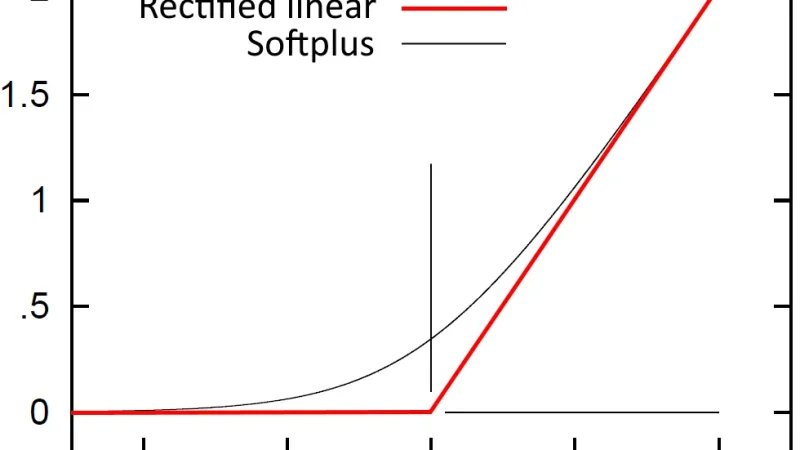
The linear function, f(x) = ax + b, is the simplest activation a neural network can use: its output is directly proportional to the input, with no non-linear transformation. It is the standard choice for the output layer in regression problems, but in hidden layers it collapses the entire network into a single linear model, so it should never be used there.
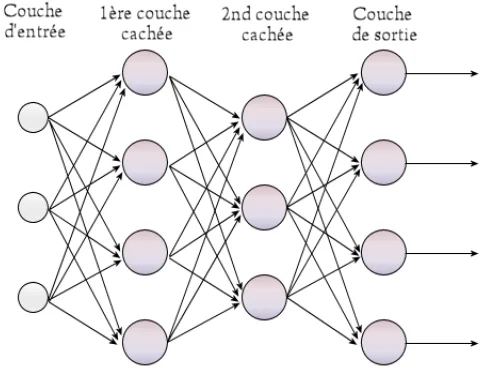
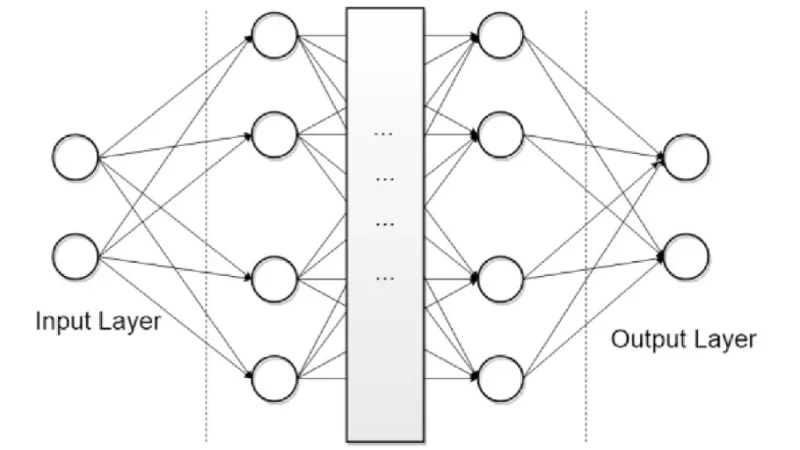
A fully connected neural network, also called a dense network, is the fundamental architecture of deep learning: every neuron in a layer connects to all neurons in the previous and next layer. This total connectivity lets it approximate any continuous function, though its computational cost grows quadratically with the number of neurons.
In a neural network, the input is represented as a column vector x in R^n that the hidden layer transforms through a weight matrix W, a bias vector b, and a non-linear activation function such as ReLU, sigmoid, or tanh. Training adjusts W and b by minimising the loss function via gradient descent and backpropagation.
A multilayer neural network consists of an input layer, one or more hidden layers, and an output layer, where each neuron weights its inputs and applies a non-linear activation function before passing the result to the next layer. Through forward propagation and backpropagation, the network adjusts millions of weights to learn hierarchical representations capable of classifying images, translating text, or generating language.
4 min1864.5
We use first- and third-party cookies to analyze site traffic. You can accept them, reject them, or configure your choice.
Learn more about cookies
Cookie preferences
NecessaryEssential for the site to work. Always on.
AnalyticsHelp us understand how the site is used (Google Analytics).