Function calling lets a model you run with Ollama on your own machine ask your code to call a function (check the weather, query a database) and use the result to answer. Ollama has supported tools since July 2024; in 2026 models such as qwen3 and llama3.3 do it with reasonable reliability.
Qwen-Agent is the Qwen team's official framework for giving their models tools: function calling, a sandboxed code interpreter, RAG and MCP. It is on version 0.0.34, released in February 2026, has around 16,800 GitHub stars and holds the canonical implementation of Qwen3 tool calling, both in the cloud and on your own machine.
Hermes 4 is the family of open-weight models Nous Research released in August 2025, in 14B, 70B and 405B parameter sizes. Its headline change is hybrid reasoning: one model answers directly or deliberates with think tags before replying, and it keeps the Hermes tool-calling format for agents.
Hermes 3 is Nous Research's family of open-weight models, fine-tuned on Llama 3.1 in 8B, 70B and 405B sizes. Its strength is tool use through JSON-formatted function calls. You can run it on your own machine with Ollama or vLLM and give it agentic capabilities without depending on a paid API.
Haystack is a Python framework by deepset, Apache 2.0 licensed, for building AI applications as pipelines of connected components: retrievers, generators and routers. Since the 2.0 rewrite it allows cycles, which lets you add an Agent component that calls tools in a loop. It serves both RAG and production agents.
Agno, the Python framework formerly known as Phidata, builds AI agents with one clear goal: performance. In our test with version 3.0.10, each agent cost about 4 microseconds and 5.5 KiB. It offers agents, teams, workflows and the AgentOS runtime, and version 3.0 requires a database migration from 2.x.
Mastra is an open-source TypeScript framework for building AI agents and applications with a single package: agents, tools, workflows, memory, RAG and evals. It was built by the team behind Gatsby, hit version 1.0 in January 2026 and connects to over 40 model providers through one interface.
Semantic Kernel is Microsoft's open-source kit for integrating AI models into C#, Python and Java through a kernel that orchestrates plugins and functions. In 2026 its successor is Microsoft Agent Framework, which merges Semantic Kernel and AutoGen; Semantic Kernel itself keeps support for at least one more year.
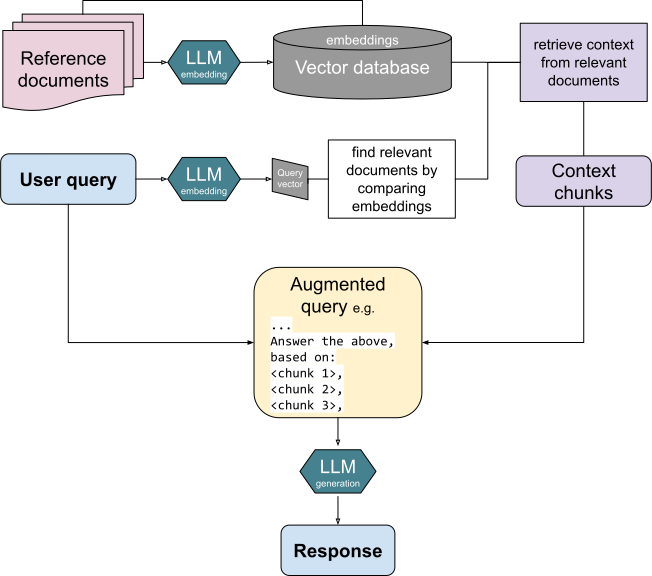
LlamaIndex is a Python framework focused on connecting your data to a language model. Its AgentWorkflow module lets you build agents that reason and call tools: FunctionAgent for models with function calling, and ReActAgent for any model. This guide shows how to turn a RAG pipeline into an agent that acts over your own documents.
Google ADK (Agent Development Kit) is Google's open-source framework for building, evaluating and deploying AI agents. It is code-first, works with Gemini and other models via LiteLLM, and offers workflow agents, tools and memory. Version 2.5.0 landed in July 2026 and deploys straight to Vertex AI.
smolagents is Hugging Face's agent library: with its logic in a single file, it lets you build an agent that reasons by writing Python instead of filling in JSON. Its CodeAgent takes around 30% fewer steps than classic tool calling, and we tested it with version 1.26.0 and a local model in Ollama.
Pydantic AI is the agent framework from the Pydantic team: you build agents in Python where every model output is validated against a type you define. You declare the expected answer as a Pydantic model and the agent guarantees that structure, with dependency injection, tools and support for more than twenty model providers.
The OpenAI Agents SDK is a lightweight Python framework for building agents and multi-agent workflows with few primitives: agents, tools, handoffs, guardrails, sessions and built-in tracing. It is the production-ready evolution of Swarm, works with the OpenAI API and with over 100 other LLMs.
Continue is an open-source coding assistant for VS Code and JetBrains that brings chat, autocomplete, inline editing and an agent mode into a single panel. Under the Apache 2.0 licence it works with more than a hundred models, including ones you run locally with Ollama, so you pick the model and keep control of your code.
Windsurf is the agentic code editor created by Codeium: a VS Code fork whose agent reads your project, plans and edits several files with your approval. In July 2025 Cognition, the company behind Devin, bought it, and on 2 June 2026 it was renamed Devin Desktop; its agent Cascade reached end of life on 1 July 2026 and was replaced by Devin Local.
Gemini CLI is Google's coding agent for the terminal: open source, with a one-million-token context window and the Gemini 3 model. Since 18 June 2026 its free tier for individuals moved to Antigravity CLI, but the tool still works with an API key from AI Studio or an enterprise licence.
Goose is an open-source AI agent created at Block that runs on your own machine as a desktop app, CLI and API. It reads and writes files, runs commands and tests, and works with more than fifteen model providers and MCP extensions. It is free, licensed under Apache 2.0, and you pay only for model usage.
OpenHands, formerly OpenDevin, is an open-source platform that solves programming tasks end to end: it takes a request, opens a sandbox container and edits files, runs commands and browses the web until it is done. It runs with Docker on your own machine and works with the model you choose.
The Codex CLI is OpenAI's coding agent that works inside your terminal: you describe a task, it reads your repository, proposes the changes and runs commands inside a sandbox you control. It is open source, installs with npm and works with your ChatGPT account or with an API key.
Roo Code is an open-source VS Code extension, born as a fork of Cline, that turns the editor into a team of agents with specialised modes (Code, Architect, Debug, Ask and Orchestrator). The project was archived in May 2026 at version 3.54.0, but its community continuation ZooCode keeps the same features alive.
Cline is a VS Code extension that turns your editor into an autonomous coding agent: it reads your project, plans changes in Plan mode and carries them out in Act mode, showing every edit as a diff you approve. It is open source and works with your own API key or with local models.
A multi-agent system splits a task across several specialised agents coordinated by a design pattern. The three most common are orchestrator-workers, where a lead agent delegates to parallel subagents; hierarchical, with teams of teams; and network, where any agent hands control to another through a handoff.
ReAct and plan-and-execute are the two control patterns for an AI agent. ReAct decides one step at a time, reasoning and acting in a loop; plan-and-execute draws up a full plan first and then executes it step by step. The former adapts better to surprises; the latter uses fewer calls and plans long tasks with more order.
Context engineering is the craft of deciding what information enters a model's window at each step of an agent. Beyond prompt engineering, it manages the whole set of tokens: instructions, tools, memory and history. Its goal is the smallest possible set of high-signal tokens that still completes the task.
Human-in-the-loop is the pattern that keeps a person inside an AI agent's decision loop: the agent stops at an approval point before an irreversible action, waits for your confirmation and resumes with its state intact. Frameworks such as LangGraph and OpenAI's Agents SDK implement it with interruptions and tool approval.
Memory is what lets an AI agent remember beyond a single conversation. Its working memory is the context window, ephemeral and limited; its long-term memory stores facts, experiences and procedures in an external store, almost always a vector database, and retrieves them when they are needed to keep acting coherently.
The reflection pattern makes an agent critique its own output and rewrite it before accepting it. One model generates, a second step evaluates and flags mistakes, and a third revises, in a loop of one or two rounds. It improves quality on tasks with clear criteria, but each cycle adds model calls, tokens and latency.
Planning lets an AI agent solve long tasks: instead of improvising step by step, it first breaks the goal into an ordered list of subtasks and then runs them. The planner-executor pattern separates thinking from acting, cuts the number of model calls and lets the agent replan when a step fails midway through the job.
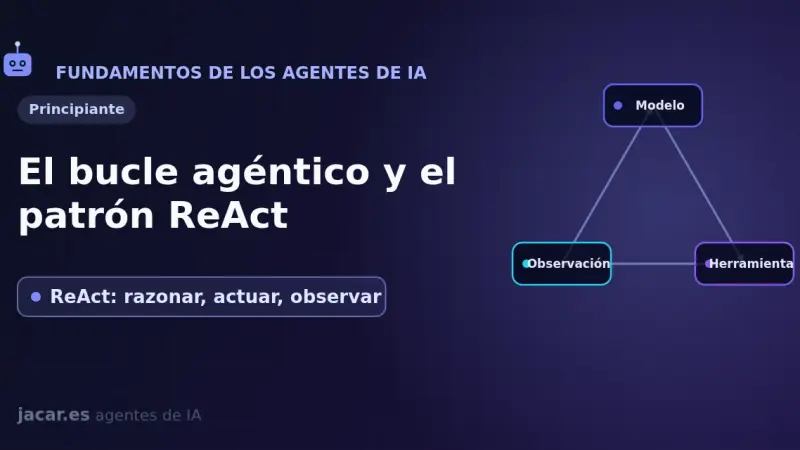
The ReAct pattern (Reason + Act) organizes an agent as a repeating three-step loop: reason about what to do, take an action with a tool, and observe the result. Introduced by Yao and colleagues in 2022, it interleaves reasoning and acting so the model can plan, consult external sources, and fix its own mistakes as it goes.
An AI agent is a program that uses a language model as its brain to decide for itself which steps to take toward a goal: it reasons, calls external tools, observes the result and repeats that loop until it is done. Unlike a chatbot, it does not just answer; it acts.
Docker Agent is a Docker CLI plugin for building and running AI agents from a declarative YAML file, no code required: you define one or more agents, give them MCP tools, run them with docker agent run, and share them through any OCI registry, on OpenAI, Anthropic, Gemini or other providers.
Open GSD (Git. Ship. Done.) is an open-source, MIT-licensed toolkit for steering coding agents without losing context: it splits work into five phases (discuss, plan, execute, verify and ship) and delegates the heavy lifting to subagents that each start with a clean context. Its core is the gsd-core engine and the gsd-pi terminal agent.
A vector embedding is a list of real numbers that represents the semantic meaning of a piece of text, an image, or any other data. Two sentences with the same meaning produce vectors that are close together; two unrelated ones produce vectors that are far apart. Semantic search, RAG, and recommendation systems are all built on this principle.
Since 2 August 2026 transparency (Art. 50) and Commission enforcement powers apply; the AI Omnibus moved Annex III high-risk to 2 December 2027. A per-system checklist with downloadable template.
Recipe for oMLX 0.6.4 on a Mac M5 Max with 128 GB: install, Claude Code and advanced settings with screenshots (Lightning MTP, VLM MTP and DFlash). Includes our own September 2026 benchmarks, with up to 1.88x more tokens per second.
This guide shows how to build a production-ready agent with the Anthropic SDK in Python: the tool-use loop with the Messages API, streaming with backpressure via a bounded queue, prompt caching with cache_control, your own MCP server registered with the Claude Agent SDK, OTel GenAI traces, and a non-root Docker container ready for production.
After eighteen months of multi-vendor adoption, MCP is the de facto standard for connecting models to tools. The complete guide: architecture, servers, policies, authentication, composition, and the antipatterns we’ve already seen in production.
While OpenAI and Anthropic dominate headlines with rounds worth hundreds of millions, a growing group of niche AI startups generates one to ten million dollars in revenue with teams of two to ten people. They share five patterns: narrow vertical focus, 70-80% margins, community distribution, iteration cycles in days, and AI as an internal lever.
The idea of UI generated on the fly instead of pre-built reached production in 2025. After a year of real-world use, the balance is more nuanced than the initial enthusiasm suggested.
Direct Preference Optimization (DPO) and its variants, IPO, KTO, and SimPO, have displaced RLHF as the preferred alignment method for language models: they drop the separate reward model, cut training cost, and are easier to reproduce. RLHF still has an edge only for frontier models with very large budgets.
Skills package reusable capabilities; subagents isolate bounded-task execution. Together they form the most effective pattern for composing complex agents in 2026.
Synthetic data has moved from a precarious substitute for real data to a central component of modern model training: the most reliable pattern expands a real core of 500 examples with thousands of synthetic paraphrases, provided you validate diversity, correctness, and distribution, and keep at least 30% real data to avoid model collapse.
The Model Context Protocol, proposed by Anthropic in late 2024 and adopted through 2025-2026 by Anthropic, OpenAI, Google, and the open-source community, already has proven operational patterns: separating generic servers from custom ones, explicit per-tool policies, credentials kept outside the model, prefixed composition, and contract tests. This is the state of the art in 2026.
Using an LLM to judge another LLM became widespread in 2024 and remains, in 2026, the only scalable way to evaluate qualitative quality in LLM systems. It is reliable when judge-human correlation exceeds 0.7 on 30 cases and gets recalibrated quarterly; below that threshold, do not trust the number.
5 min4184.7
We use first- and third-party cookies to analyze site traffic. You can accept them, reject them, or configure your choice.
Learn more about cookies
Cookie preferences
NecessaryEssential for the site to work. Always on.
AnalyticsHelp us understand how the site is used (Google Analytics).