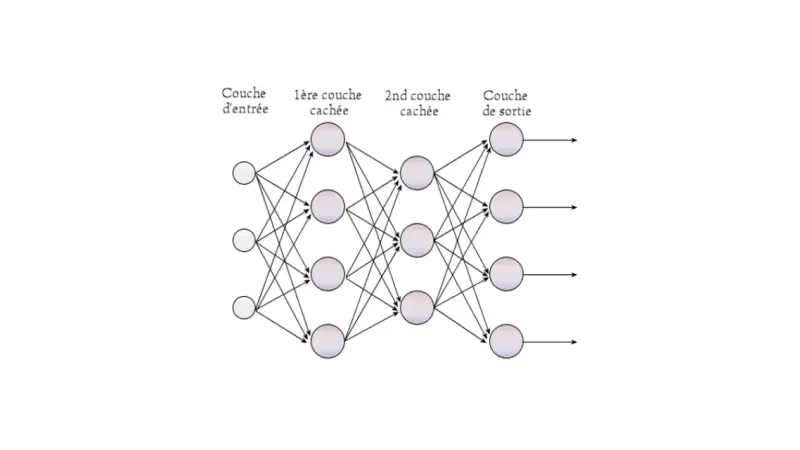
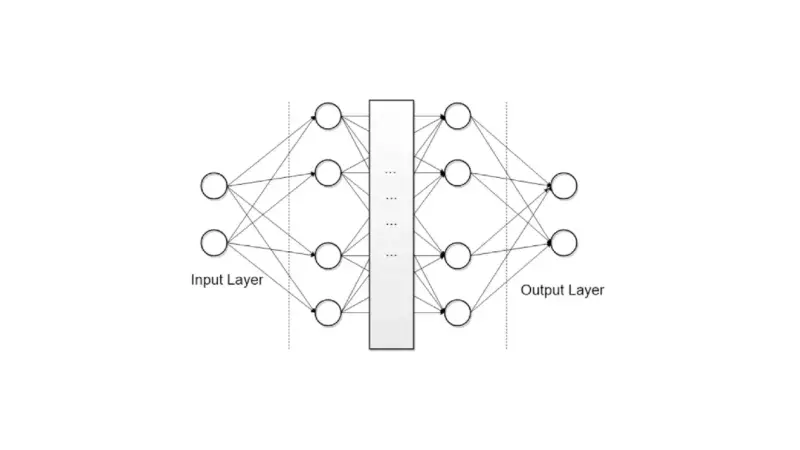
A multilayer neural network consists of an input layer, one or more hidden layers, and an output layer, where each neuron weights its inputs and applies a non-linear activation function before passing the result to the next layer. Through forward propagation and backpropagation, the network adjusts millions of weights to learn hierarchical representations capable of classifying images, translating text, or generating language.
Spark DataFrames are distributed, schema-based tables that the Catalyst engine optimises automatically, while pipelines chain those transformations into a reproducible end-to-end flow. Together they let you process large data volumes efficiently across a cluster, scaling from a laptop to hundreds of nodes without rewriting code.
LazyPredict is a Python library that automatically evaluates dozens of scikit-learn classification and regression models on your dataset in seconds, without writing training code for each one. LazyClassifier and LazyRegressor return a comparative metrics table that shows which models are worth tuning further.
AI optimises B2B sales through four levers: predictive lead scoring that prioritises the buyers most likely to close, conversation analysis, at-scale outreach personalisation and automating repetitive tasks. Its real impact depends on starting from clean CRM data.
Transfer learning lets you reuse a model already trained on a massive dataset, such as ImageNet or a large text corpus, to solve a new task with far less proprietary data and compute time. It works through fine-tuning, feature extraction, or prompting, and it performs best when the source and target domains are similar to each other.
Adversarial machine learning studies deliberate attacks on AI systems (evasion, poisoning and model extraction) and the defenses used to resist them, chiefly adversarial training, robustness certification and monitoring the distribution of production input data.
Recommendation systems are the invisible engine behind Netflix, Amazon, and Spotify. Collaborative filtering predicts individual preferences by analysing the behaviour of millions of users without examining item content: 80% of what Netflix viewers watch and 35% of Amazon sales come from algorithmic recommendations.
Explainable AI (XAI) is the set of techniques that open the black box of AI models and answer why they made a given decision. Methods such as LIME, SHAP and Grad-CAM activation maps are the most widely used. Its adoption is mandatory in regulated environments: healthcare, justice, and financial services.
Reinforcement learning is the AI technique in which an agent learns to make optimal decisions through trial and error, without labelled data: it acts in an environment, receives a reward or penalty based on the outcome, and adjusts its strategy to maximise long-term cumulative reward.
Computer vision is the branch of artificial intelligence that lets machines interpret digital images: detecting objects, segmenting regions and recognising patterns through convolutional neural networks. Since 2012, when AlexNet cut ImageNet classification error to 15.3%, it has spread into manufacturing, medicine, transport and precision agriculture.
7 min2614.7
We use first- and third-party cookies to analyze site traffic. You can accept them, reject them, or configure your choice.
Learn more about cookies
Cookie preferences
NecessaryEssential for the site to work. Always on.
AnalyticsHelp us understand how the site is used (Google Analytics).